
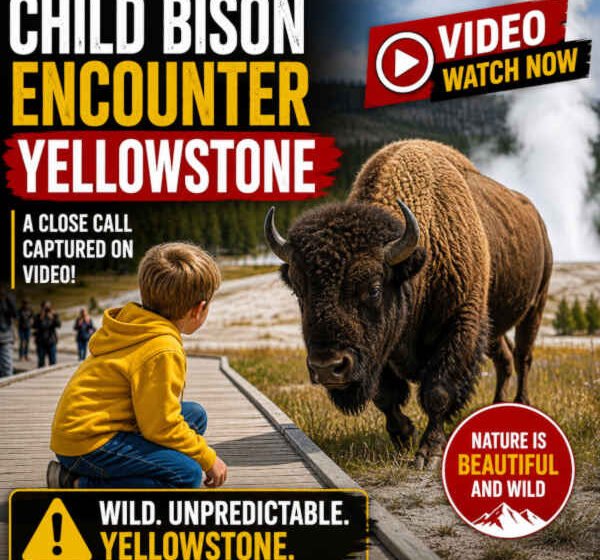

WYOMING: A heart-stopping video circulating online has re-ignited national conversations around wildlife safety and visitor behaviour after capturing a dramatic child bison encounter in Yellowstone National Park.
The viral footage, captured by park visitor Brittany Peteler, shows a massive wild bison moving toward a wooden boardwalk path as tourists look on. In the video, a woman walks past the animal, ignoring its proximity as it edges closer to the walkway. Though she safely reaches the opposite side, tension quickly mounts as a family group carrying and leading small children steps onto the path, walking directly toward the towering animal.
Moments later, as onlookers gasp in disbelief, one of the young children breaks into a run, triggering the bison to briefly charge and chase after the child. While the child managed to escape unharmed, the close call serves as a stark reminder of the dangers posed when park visitors fail to maintain required distances from wild animals.
Anatomy of the Incident: What Happened on the Boardwalk
Witnesses present during the child bison encounter in Yellowstone described a situation that rapidly escalated from a casual sightseeing walk into a potentially life-threatening emergency.
According to eye-witness accounts and video logs recorded by Brittany Peteler:
-
Initial Movement: A solitary bison slowly approached a boardwalk trail where multiple tourists were walking.
-
The First Pass: An adult woman walked directly past the animal along the narrow wooden path, barely maintaining a few feet of clearance.
-
The Group Advance: Despite visible warnings and gasps from watching bystanders, another family group,p including young children, en continued walking straight toward the approaching animal.
-
The Charge: As a child accelerated into a sprint near the animal, the bison abruptly agitated and lunged forward, giving chase before stopping short.
Park experts note that running in the presence of large wild herbivores is one of the most dangerous actions a visitor can take, as fast motion can trigger a defensive charge response from an already stressed animal.
Recent Animal Encounters in Yellowstone
This high-profile child bison encounter in Yellowstone is not an isolated event. According to official statistics provided by the National Park Service (NPS), bison have injured more people in Yellowstone National Park than any other animal, including bears and wolves.
                  YELLOWSTONE WILDLIFE SAFETY DISTANCES
┌────────────────────────────────────────────────────────────────────────┐
│  Bison, Elk, Deer, Moose, Coyotes  ►  Minimum 25 Yards (75 Feet)      │
│  Bears and Wolves                  ►  Minimum 100 Yards (300 Feet)    │
└────────────────────────────────────────────────────────────────────────┘
The incident follows a string of recent hazardous wildlife encounters throughout the park:
-
Mud Volcano Injury: Earlier this season, a 12-year-old visitor sustained injuries near the Mud Volcano hydrothermal area after being struck by a bison.
-
Old Faithful & Lake Village Attacks: Previous seasons saw multiple adult tourists gored after approaching bison too closely near major visitor hubs, including Old Faithful Geyser and Lake Village.
-
Pebble Creek Incident: In another viral incident captured near Pebble Creek, a tourist drew widespread public criticism after walking a toddler within arm’s reach of a grazing male bison.
Understanding Bison Behaviour and Physical Capabilities
Many park visitors mistakenly view bison as slow, docile cattle due to their passive appearance while grazing. However, wildlife biologists emphasise that North American bison (Bison bison) are wild, powerful, and notoriously unpredictable.
| Physical Attribute | Bison Capacity / Metric | Safety Impact for Visitors |
| Weight | Up to 2,000 lbs (Males) / 1,000 lbs (Females) | Massive impact force capable of throwing a human. |
| Top Running Speed | Up to 35 mph (56 km/h) | Runs three times faster than the average human sprint. |
| Agility | High (Vertical jumps up to 6 feet) | Can turn rapidly and leap over park fences/obstacles. |
| Agitation Signs | Pawing ground, tail raised, snorting | A tail held straight up signals an imminent charge. |
“Wild animals can be aggressive when people do not respect their space. Visitors are responsible for staying at least 25 yards away from all large animals, including bison, elk, bighorn sheep, deer, moose, and coyotes.”
: National Park Service Official Safety Statement
National Park Service Guidelines & Federal Regulations
To protect both human lives and wildlife populations, federal regulations enforce strict spatial boundaries within national park grounds.
Official Visitor Rules
-
Minimum Distance Requirements: Guests must maintain a distance of at least 25 yards (75 feet) from bison, elk, deer, moose, and coyotes, and 100 yards (300 feet) from bears and wolves.
-
Yielding the Right of Way: If an animal moves toward a boardwalk or trail, visitors must back away slowly to maintain the 25-yard buffer.
-
Prohibition of Encitement: It is illegal under federal law to yell at, entice, or approach wildlife for photographs or video recordings.
Legal Consequences
Violating wildlife distance rules in a National Park is a federal offence punishable by fines up to $5,000, potential court appearances, and possible jail time under the Superintendent’s Compendium regulations.
Essential Safety Protocols for Families Visiting Yellowstone
To prevent another dangerous child bison encounter in Yellowstone, rangers and wildlife safety experts urge parents and tour groups to review safety procedures before entering park gates:
-
Keep Children Close: Never allow young children to walk or run ahead on boardwalks or wooded trails. Always hold hands when wildlife is visible nearby.
-
Use Telephoto Lenses: Capture close-up photos using optical zoom or telephoto camera gear rather than physically stepping closer to an animal.
-
Recognise Warning Signs: If a bison shakes its head, paws the dirt, snorts, or raises its tail into a hook shape, it is agitated and preparing to charge. Immediately back away.
-
Never Run Away: Running can trigger a predator-chase instinct or an aggressive defensive rush. If a bison approaches, walk away slowly while keeping your eye on the animal. Place large objects—such as trees, benches, or parked vehicles—between yourself and the bison if necessary.
Frequently Asked Questions (FAQs)
Was anyone hurt during the recent child bison encounter in Yellowstone?
No injuries were reported during the specific boardwalk incident caught on video by Brittany Peteler. However, the event prompted widespread safety warnings from park officials following other recent goring incidents in the park.
How far away should visitors stay from bison in Yellowstone?
Visitors must stay at least 25 yards (75 feet) away from bison at all times. During summer mating seasons (the rut) or when calves are present, giving even greater distance is strongly recommended.
Why are bison so aggressive toward humans?
Bison are wild, non-domesticated prey animals that perceive a close human approach as a direct threat. When their personal space is invaded, they defend themselves by charging, kicking, or tossing intruders using their sharp horns.