
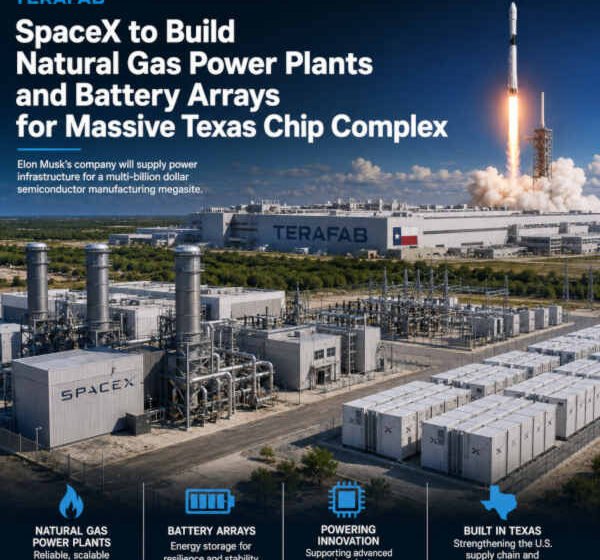

GRIMES COUNTY, Texas: Facing the colossal electrical demands of constructing the world’s largest semiconductor manufacturing hub, SpaceX is taking energy infrastructure into its own hands. Rather than relying strictly on the local commercial electrical grid, the company plans to build dedicated natural gas-fired power plants and massive industrial battery storage arrays to power “Terafab”—a 100 million-square-foot combined semiconductor fabrication campus developed alongside Tesla Inc.
The off-grid power strategy was detailed by SpaceX leadership during a public meeting in rural Grimes County, where community members, school district trustees, and local officials gathered to examine the infrastructural plans for the multi-billion-dollar project.
“We’re bringing our own power,” declared Riley Trettel, who oversees energy and data centre development for SpaceX. “We’re going to be building natural gas-fired power plants, and we’re going to be building very large battery arrays to store energy.”
The move highlights a growing trend among tech giants and advanced manufacturers: as computing and high-tech fabrication power requirements soar, traditional utility grids are often unable to supply the necessary speed, capacity, or uninterrupted reliability required for modern chipmaking.
Inside Terafab: A Vertical Semiconductor Megastructure
Announced by Elon Musk and backed by major Texas economic development grants, Terafab represents an unprecedented undertaking in American technology manufacturing. Situated near the former Gibbons Creek power station in Grimes County, the complex is designed to consolidate the entire semiconductor supply chain under a single roof.
Where traditional chip manufacturing relies on a scattered global chain—designing silicon in one region, fabricating wafers in another, and shipping them overseas for assembly, testing, and packaging—Terafab will perform every stage on-site.
┌─────────────────────────────────────────────────────────┐
│                 TERAFAB AT A GLANCE                     │
├─────────────────────────────────────────────────────────┤
│  • Planned Complex Size: 100 Million Sq. Ft.            │
│  • Initial Phase Investment: $16.8 Billion              │
│  • Total Long-Term Investment: Up to $119 Billion       │
│  • Target Annual AI Compute: 1 Terawatt                 │
│  • Key Project Partners: SpaceX, Tesla, Intel           │
│  • Initial High-Tech Direct Jobs: 3,000+ Position       │
└─────────────────────────────────────────────────────────┘
The facility aims to resolve a persistent bottleneck in high-end compute hardware. Existing global fabs currently produce only a small fraction of the specialised silicon required for Tesla’s autonomous vehicles, Optimus humanoid robots, and SpaceX’s orbital AI satellite infrastructure. Intel has also partnered on the initiative, contributing manufacturing expertise and licensing its advanced 14A (1.4 nanometer) process technology.
Why Independent Natural Gas Power Is Critical
Semiconductor fabrication plants (fabs) are among the most power-intensive industrial operations in existence. Cleanrooms must maintain continuous ultra-pure air filtration, while advanced lithography machines, chemical vapour deposition units, and high-temperature furnaces operate around the clock. Even a fraction-of-a-second voltage drop can destroy millions of dollars in delicate silicon wafers.
By constructing on-site natural gas generators paired with utility-scale battery storage, SpaceX achieves three strategic advantages:
-
Uncompromised Reliability: Isolates cleanrooms and lithography equipment from regional grid fluctuations, severe weather events, or unexpected blackouts.
-
Rapid Deployment Timeline: Bypasses years-long delays associated with regional power line construction and utility grid interconnect approvals.
-
LoadStabilisation: High-capacity battery arrays store surplus power, smoothing out peak energy draws during intensive computing and processing cycles.
Given the strain on the Electric Reliability Council of Texas (ERCOT) grid from rapid industrialisation and data centre expansions, generating electricity on-site ensures Terafab remains operational without competing for residential power supplies in surrounding rural towns.
State Backing and Local Community Impact
The project has received substantial support from state leadership. Texas Governor Greg Abbott recently announced a $30 million Texas Enterprise Fund (TEF) performance grant awarded to SpaceX, alongside tax incentive qualifications under the Texas Jobs, Energy, Technology, and Innovation (JETI) program.
“Texas is where big ideas grow even bigger,” Governor Abbott said. “The first-of-its-kind Terafab facility will accelerate chip production in Texas at an unprecedented scale, create thousands of good-paying jobs in Grimes County, and expand economic opportunity for generations of Texans across Southeast Texas and beyond.”
For Grimes County, the arrival of Terafab represents a massive economic transition.
| Economic Metric | Project Impact |
| Direct Employment | 3,000+ engineers, cleanroom operators, and technicians in Phase 1. |
| State Grant Funding | $30 million performance grant via the Texas Enterprise Fund. |
| Local Education Funding | Incentive agreements were established with the Iola ISD Board of Trustees. |
| Regional Supply Chain | Influx of specialised chemical suppliers, equipment technicians, and logistics hubs. |
“This is a generational change for Grimes County,” stated Grimes County Judge Joe Fauth III. “Connecting a company like SpaceX and the Terafab project to develop an industrial site in Grimes County makes all the sense in the world.”
Environmental Planning and Resource Management
Building large-scale natural gas generation and semiconductor manufacturing facilities requires careful environmental planning. In addition to fuel emissions from gas turbines, semiconductor plants consume significant quantities of water for chemical processing and ultra-pure wafer rinsing.
SpaceX representatives outlined several measures to address resource conservation:
-
Battery Optimisation: Industrial battery arrays allow natural gas turbines to run at steady, optimal efficiency levels, avoiding wasteful fuel idling.
-
Reused Infrastructure: The facility utilises land adjacent to the former Gibbons Creek power plant, leveraging existing industrial zoning and water rights.
-
Water Conservation: Closed-loop filtration systems are planned to reclaim and recycle up to 90% of process water, minimising environmental impact on local groundwater reserves.
A New Benchmark for Domestic Chip Production
As initial ground preparation continues in Southeast Texas, Terafab sets a new precedent for American high-tech manufacturing. By combining advanced sub-nanometer chip fabrication with independent, on-site energy production, SpaceX and Tesla are building a resilient template for industrial scale—ensuring the hardware powering future autonomous systems, space technology, and artificial intelligence remains secured on domestic soil.