
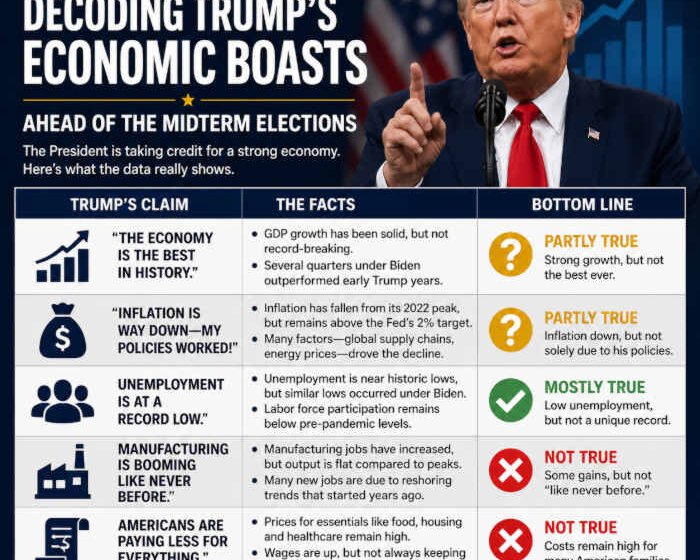

WASHINGTON: President Donald Trump has doubled down on his economic narrative, delivering speeches at venues across the country—including a high-profile rally in Las Vegas—highlighting record-breaking stock market numbers, a surge in manufacturing, and historic employment figures.
However, as the November 3 midterm elections draw near, public sentiment tells a drastically different story. According to a recent AP-NORC Centre for Public Affairs Research poll, only 32% of U.S. adults approve of Trump’s handling of the economy, while 69% characterize current economic conditions as “poor”. High inflation, elevated gas prices, and the everyday costs of essentials like groceries remain severe pain points for the majority of American households.
Below is an independent, fact-checked breakdown analysing the claims, data, and context behind the administration’s economic rhetoric.
1. Employment and Total Job Numbers
-
The Claim: “More Americans are working in the United States right now than at any point in the history of our country.”
-
The Reality: True, but it heavily lacks context.
-
The Data: Non-farm U.S. payrolls reached roughly 159 million in mid-2026, marking an all-time statistical peak. Because the overall population grows, total employment figures naturally reach new records in most non-recession years—U.S. payrolls have expanded in 65 of the last 80 years.
-
Underlying Trend: While total employment is high, the rate of job creation has slowed dramatically. Monthly job additions have averaged roughly 92,000—a steep decline compared to the monthly average of 329,000 jobs seen across the previous administration’s four-year tenure, or the 166,000 monthly average during the 2023–2024 period. Analysts attribute the slowdown to sustained high interest rates, aggressive immigration enforcement that has tightened labour supply, and a wave of retiring Baby Boomers.
2. Wall Street and Stock Market Milestones
-
The Claim: “The stock market has set 74 all-time highs just since our short time that we’ve been back.”
-
The Reality: Mostly True.
-
The Data: Investment tracking firm CFRA confirms that the benchmark S&P 500 index has set 74 all-time highs since the 2024 presidential election, and 64 since Trump took office for his second term.
-
Underlying Trend: Strong corporate earnings—particularly among major tech and artificial intelligence firms—have pushed the market upward. However, financial analysts note that Wall Street performance does not directly reflect household prosperity, as the majority of stock wealth remains concentrated among top-income earners. Additionally, geopolitical tension surrounding fuel routes and international trade continues to fuel market volatility.
3. Manufacturing Growth and Factory Jobs
-
The Claim: Massive tariffs and industrial policies have triggered an unprecedented boom in domestic manufacturing and factory hiring.
-
The Reality: Exaggerated.
-
The Data: Despite aggressive protective tariffs on imported goods, U.S. manufacturing employment has not experienced a hiring boom. Data shows the country actually has approximately 95,000 fewer manufacturing jobs than it did at the start of 2025. Factory hiring has averaged just 3,000 jobs per month this year.
-
Underlying Trend: Industrial tariffs have raised the cost of imported raw materials—such as aluminium and steel—for domestic manufacturers. Furthermore, modern facilities rely heavily on automation and advanced robotics, meaning increased physical plant production no longer creates the high-volume assembly line jobs seen in previous decades.
Economic Indicators at a Glance
| Economic Metric | Admin Claim / Milestone | Fact-Checked Context |
| Total Payrolls | Record total workers (~159M) | Population growth naturally drives records; the hiring rate has slowed. |
| S&P 500 Highs | 74 new records post-election | Accurate; driven by corporate AI profits, but wealth remains unequal. |
| Factory Jobs | Manufacturing hiring boom | Down 95,000 jobs since early 2025 due to automation and input costs. |
| Goods Exports | On track for a record $2.5 Trillion | Pacing higher year-over-year (~$1.25T through June), though monthly volume fluctuates. |
| Public Sentiment | Strong economic performance | Only 32% approve of economic handling; 69% rate the economy as “poor.” |
The Political Stakes Ahead of the Midterms
Economic perception remains the dominant issue shaping voter behaviour ahead of November. While top-line financial indicators like equity markets and total export valuations show resilience, everyday consumers continue to face squeezed household budgets.
With the administration pushing its economic narrative on the campaign trail, the gap between Wall Street milestones and Main Street sentiment presents a major hurdle for congressional Republicans seeking to retain legislative majorities. Whether the administration’s messaging on job totals and market gains can overcome widespread frustration regarding everyday living costs will be tested at the ballot box.