
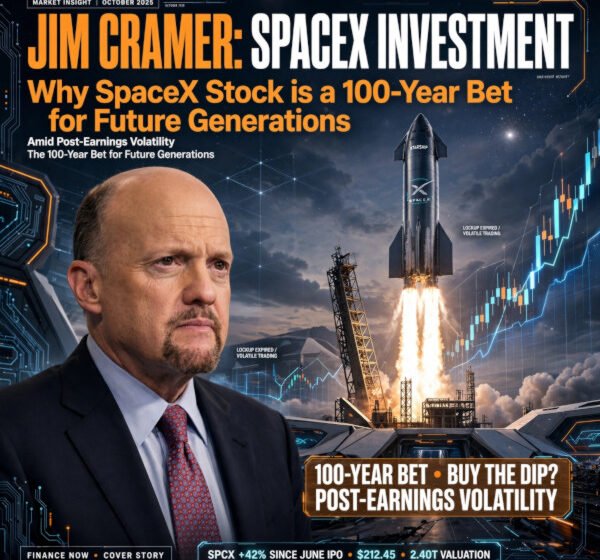

NEW YORK: Shares of Space Exploration Technologies Corp. (NASDAQ: SPCX) experienced significant pressure following the release of the company’s financial results, dropping 13.61% in a single trading session and marking five consecutive weeks of declines. Despite Wall Street’s immediate anxiety surrounding massive capital expenditure (CapEx) outlays and a major post-IPO lock-up expiration, CNBC Mad Money host Jim Cramer is urging market participants to look far beyond quarterly shortfalls.
In a passionate commentary, Cramer framed SpaceX not as a standard short-term growth asset, but as a multigenerational wealth vehicle reminiscent of historical infrastructure plays. Comparing the company to 100-year railroad bonds issued during the Industrial Revolution, Cramer urged investors to evaluate SpaceX’s potential over decades rather than days
The Market Reaction: Revenue Outperformed by Massive CapEx
SpaceX posted financial metrics for its recent quarter that highlighted rapid top-line growth. Total revenue reached $7.81 billion, representing a 92% increase year-over-year and comfortably surpassing Wall Street estimates of $6.93 billion. The company closed the period holding $100 billion in cash and cash equivalents alongside a robust $47.5 billion order backlog.
However, equity markets pivoted heavily toward the spending ledger. SpaceX reported quarterly capital expenditures totalling $18.4 billion, exceeding Wall Street projections by over $5 billion. Of that total spending, approximately $15.8 billion was allocated toward building out artificial intelligence (AI) and orbital computing infrastructure.
| Financial Metric | Reported Value | Wall Street / Prior Benchmark | Strategic Significance |
| Q2 Revenue | $7.81 Billion | $6.93 Billion (Estimated) | 92% YoY growth driven by Starlink & AI compute |
| Capital Expenditure | $18.4 Billion | Exceeded estimate by >$5B | Intensive investment in AI data centers & hardware |
| Cash Reserves | $100.0 Billion | Solid liquid cushion | Balance sheet strength to absorb near-term burn |
| Contract Backlog | $47.5 Billion | High revenue visibility | Sustained multi-year demand across commercial/defense |
| Starlink Subscribers | ~12.0 Million | ~6.0 Million (Prior Year) | Subscription engine doubling user base across 160+ markets |
This aggressive capital outlay left free cash flow deeply negative for the quarter, triggering concerns among institutional fund managers who are sensitive to near-term profitability metrics amid shifting macroeconomic conditions.
Lock-Up Expirations and Share Dilution
Compounding the post-earnings pull-back is a substantial increase in tradable equity float. Following the company’s recent public offering, the initial post-IPO lock-up expiration freed approximately 911 million to 912 million restricted shares.
-
Float Expansion: Active outstanding shares eligible for public trading expanded from roughly 639 million to over 1.55 billion, injecting over $100 billion worth of newly tradable equity into the open market.
-
Insider Hold-Outs: CEO Elon Musk—who maintains approximately 42% ownership of SpaceX—remains bound by equity lock-up agreements preventing personal share liquidation until one year post-IPO. Other senior executive officers face staggered release timelines extending through late 2026 and mid-2027.
While the influx of share supply presents a temporary mechanical overhang on the stock price, analysts note that such lock-up expirations frequently create attractive secondary entry points for long-term institutional investors seeking allocation in high-moat growth assets.
The Core Growth Drivers: Beyond Rocket Launches
Jim Cramer’s long-term bullish thesis rests on three core pillars that transition SpaceX from a traditional aerospace launch provider into an irreplaceable utility and technology conglomerate.
                             SpaceX Growth Ecosystem
                                        │
      ┌─────────────────────────────────┼─────────────────────────────────┐
      ▼                                 ▼                                 ▼
Starlink Internet              Orbital AI Compute                 Lunar & Deep Space
 (12M Subscribers)             ("Neocloud" Model)                 (Starship Fleet)
Primary recurring cash flow     Solar-powered data nodes           Infrastructure for future
engine funding compute.         partnered with AI leaders.         extraterrestrial commerce.
1. Starlink Satellite Connectivity
Starlink has matured into SpaceX’s primary revenue engine. Currently operating in over 160 global markets with 12 million active subscribers, the constellation provides high-margin broadband services to maritime, aviation, consumer, and defence sectors worldwide. The predictable recurring cash flows generated by Starlink provide a stable foundation to fund higher-risk, capital-intensive futuristic ventures.
2. Orbital AI Data Centres & The “Neocloud” Transition
SpaceX is actively positioning itself as an emerging player in global AI compute infrastructure. With ground-based data centres facing power grid bottlenecks and regulatory constraints, solar-powered orbital data centres represent a novel solution for training massive generative AI models.
-
The company has already executed compute-rental agreements with major AI powerhouses, including Anthropic and Alphabet Inc.’s Google.
-
Management projects finishing 2026 with over two gigawatts of operational compute capacity, delivering an estimated payback period on new AI hardware investments of under twelve months.
3. Starship Infrastructure and Extraterrestrial Economy
Through its heavy-lift Starship platform, SpaceX is building the logistics backbone required for permanent lunar bases and deep-space orbital stations. As government and commercial lunar programs accelerate under the Artemis initiative and private space commerce, orbital real estate and planetary transport are anticipated to become multi-trillion-dollar economic categories by mid-century.
Wall Street Divided: Generational Value vs. Valuation Drag
Wall Street remains polarized on how to price SpaceX’s unprecedented capital deployment strategy.
On the bullish side, growth-focused portfolio managers align with Cramer’s assessment, noting that Elon Musk has a proven history of managing capital-intensive enterprises—such as Tesla during its early vehicle ramps—through high-burn phases into high-margin dominance. Management’s long-term directional target envisions annual corporate revenues reaching $1 trillion by 2030, with optimistic scenarios pointing toward 2029.
Conversely, short sellers and traditional value analysts caution against paying inflated multiples for negative free cash flow businesses during periods of share inflation. Sceptics argue that until orbital data centres prove operational efficiency at scale, the heavy spending burdens equity holders with unquantified operational risks.
Strategic Portfolio Guidance for Retail & Institutional Investors
For individual investors assessing Cramer’s Jim Cramer SpaceX investment thesis, financial planners emphasise the importance of matching investment horizons with risk tolerance and portfolio allocations:
-
Adopt Dollar-Cost Averaging (DCA): Given the near-term volatility driven by lock-up share releases and quarterly CapEx updates, building positions incrementally over several quarters can help mitigate entry-price risk.
-
Horizon Alignment: SpaceX stock is best suited for long-term growth portfolios, retirement accounts, or generational trust funds with timeframes spanning 10 to 30+ years.
-
Monitor AI Compute Execution: Investors should closely track upcoming quarterly updates on gigawatt compute deployments and enterprise AI cloud contracts to verify that capital expenditures continue yielding fast payback cycles.
While short-term traders may continue reacting to headline volatility and supply absorption, the structural expansion of space infrastructure, global satellite telecommunications, and orbital computing suggests that SpaceX’s ultimate value proposition may indeed mirror the transformational economic impact of the 19th-century railroad networks.