
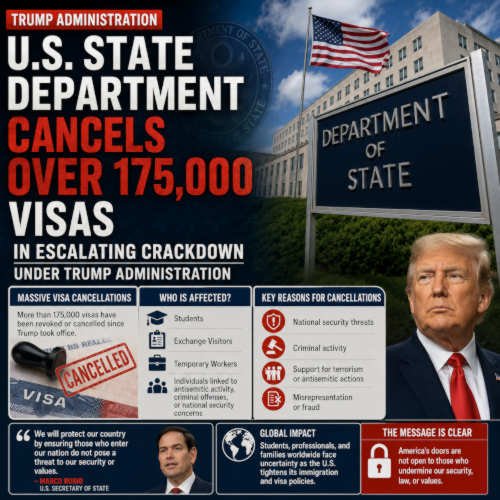

WASHINGTON : The Trump administration announced on Monday that it has revoked more than 175,000 visas from foreign nationals, citing non-compliance with visa conditions, criminal activity, calls for violence against Americans, and broader national security threats.
According to the U.S. State Department, the vast majority of these cancellations were triggered by law enforcement encounters. The announcement represents a significant acceleration in the administration’s visa cancellation operations, averaging over 10,000 visa revocations per month in 2026—up from roughly 8,000 cancellations per month throughout 2025. In January, officials had previously disclosed that more than 100,000 visas were revoked over the preceding year.
Expanded Scope of “Continuous Vetting” Operations
The administration framed the sweeping cancellations as part of the State Department’s expanded continuous vetting infrastructure. Designed to monitor visa holders after entry or issuance, the system checks immigration status against updated law enforcement data, social media monitoring, and federal security databases.
“The revocations come as a result of the State Department’s continuous vetting operations, which ensure that visa recipients abide by the terms of their visa and do not endanger Americans,” the State Department said in a statement released Monday. “Under President Trump and Secretary Rubio’s leadership, the State Department will continue to identify, investigate, and revoke the visas of foreign nationals who threaten the safety of the American people.”
| Category | Primary Offenses / Triggers | Key Case Examples Highlighted |
| Criminal Activity | Assault, driving under the influence (DUI), theft, drug crimes, reckless driving. | Individuals charged with felony rape, human trafficking, sexual battery, or child exploitation. |
| Financial Fraud | Business fraud, embezzlement, Medicaid healthcare scams, falsifying company revenues. | A $5 million Medicaid fraud scheme and forged documentation used to secure investor visas. |
| Political Rhetoric & Threats | Statements endorsing violence against U.S. leaders or citizens. | Foreign nationals celebrating the September 2025 assassination of right-wing activist Charlie Kirk. |
| Foreign Policy Grounds | Ties to hostile regimes or foreign influence operations. | Deportations of Cuban and Iranian nationals linked to state regimes, and a Kuwaiti national uttering threats. |
| Immigration System Abuse | Fraudulent travel, improper birth tourism schemes. | Over 100 visas revoked by a U.S. Embassy in North Africa targeting parents traveling primarily to secure citizenship. |
Political Rhetoric and Foreign Policy Deportations
A notable aspect of the State Department’s report involves visa revocations grounded in ideological speech and foreign policy determinations.
The State Department highlighted several instances where foreign nationals had their visas canceled after celebrating the September 2025 assassination of conservative political activist Charlie Kirk. Officials cited social media posts and public statements made by visa holders, including comments such as “when fascists die, democrats don’t complain” and remarks stating Kirk “died too late.”
Foreign policy grounds were also cited in high-profile deportations, including:
-
Tou Lue Vang: A 42-year-old father of six deported to Laos by the Department of Homeland Security. Although Minnesota Governor Tim Walz had pardoned Vang for a 2005 conviction involving the sexual abuse of a minor, the State Department proceeded with his removal on foreign policy grounds.
-
Foreign Regime Affiliations: Visas were revoked for Cuban nationals tied to government influence operations and Iranian nationals with active links to the Iranian government.
-
Direct Threats: A Kuwaiti national was stripped of his visa after wishing violence against the U.S. president and publicly declaring Americans to be his “enemy.”
Crackdown on Birth Tourism and Healthcare Fraud
The report also detailed targeted efforts against organized exploitation of the U.S. immigration and healthcare systems. A U.S. Embassy in North Africa revoked more than 100 visas after identifying parents participating in “birth tourism”—traveling to the United States on temporary visitor visas primarily so their children would acquire birthright citizenship.
In the healthcare sector, officials cited cases where foreign business owners fabricated revenues or engaged in multi-million-dollar Medicaid fraud schemes while residing in the country on temporary worker or investor visas.
Pushback from Immigration Advocates
The surge in visa cancellations has drawn sharp criticism from immigration attorneys and civil rights advocates. Many argue that using “law enforcement encounters” as a baseline for revocation risks penalizing individuals who face minor traffic infractions, false allegations, or charges that were ultimately dismissed without reaching a judicial verdict.
In response to concerns regarding due process, the State Department maintained a firm stance on the executive branch’s discretionary authority over visa issuance and retention.
“A U.S. visa is a privilege, not a right,” the State Department reiterated. “The Department remains committed to using every tool available to protect our communities from those who abuse it.”