
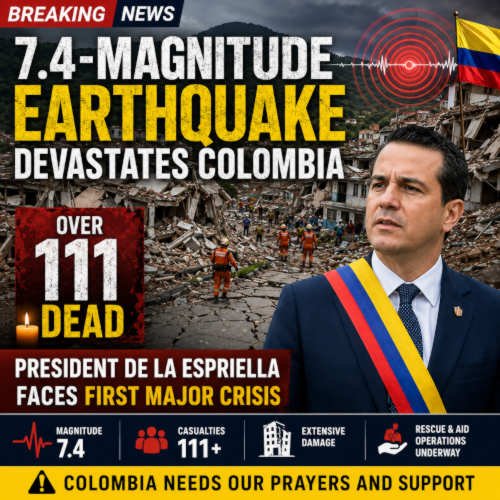

BOGOTÁ, Colombia — A powerful 7.4-magnitude earthquake struck western Colombia on Monday morning, killing at least 111 people, injuring scores more, and reducing dozens of buildings to rubble. The disaster marks the first severe leadership challenge for President Abelardo de la Espriella, who assumed office just three days prior on Friday.
The seismic shock occurred at 7:34 a.m. local time, centred near the rural municipality of San José del Palmar in the Pacific coastal department of Chocó, roughly 250 miles west of Bogotá. According to the U.S. Geological Survey and the Colombian Geological Service, the earthquake struck at an intermediate depth of roughly 60 to 68 miles (96 to 110 kilometres). Despite its depth, the sheer magnitude rattled structures across western Colombia and sent shocks through neighbouring Ecuador, Panama, and Venezuela.
Wide Areas of Destruction Across Western Cities
The earthquake wreaked extensive havoc across Colombia’s western mountainous corridor and Pacific region:
-
Cali: In Colombia’s third-largest city, Mayor Alejandro Eder confirmed that at least 19 buildings collapsed, trapping residents beneath heavy concrete and masonry. Clouds of dust billowed over neighbourhoods as rescue crews and residents frantically dug through debris with bare hands and specialised gear.
-
Pereira: Capital of the Risaralda region and heavily impacted, Pereira reported severe structural destruction. Dozens of residential structures collapsed, while partial damage at Matecaña International Airport forced a temporary suspension of regional flights.
-
Manizales: In the coffee-growing department of Caldas, tremors sheared off one of the iconic towers of the neo-Gothic Cathedral Basilica of Our Lady of the Rosary, sending rubble crashing into the nave below.
-
San José del Palmar & Quibdó: Near the epicentre in Chocó—one of Colombia’s most economically vulnerable regions—dozens of homes were destroyed. Severed communication lines and damaged roads initially hindered emergency access to remote communities.
Government Response and measures taken up
Speaking from the headquarters of the National Unit for Disaster Risk Management (UNGRD) in Bogotá, President Abelardo de la Espriella officially declared a state of national emergency to expedite relief funds and mobilise military logistics.
“You are not alone. The state is present and taking action,” President de la Espriella stated in an address to the nation. “We aren’t going to leave people alone. They are in our hearts, and we are going to tend to people with our full determination.”
The president confirmed he would travel directly to the hardest-hit zones to coordinate rescue operations. Emergency crews, civil defence units, and canine search teams have been deployed across 20 affected municipalities.
Seismic Context and Regional Impact
Seismologists noted that this was the highest-magnitude earthquake recorded in Colombia in over a decade. Colombia lies along the Pacific “Ring of Fire”—a high-seismic zone where tectonic plate collisions frequently cause tremors. While minor quakes are a regular feature of life in the Andes, Monday’s event triggered multiple aftershocks measuring up to 4.8 magnitude, raising continuous fears of further structural failures.
Offers of international assistance and humanitarian aid have poured in from neighbouring nations, including Ecuador, Brazil, Mexico, and the United States. Authorities warn that the death toll of 111 is expected to climb significantly as rescue workers clear collapsed multi-story buildings and establish contact with isolated rural towns in the Chocó region. Emergency management agencies continue to urge residents in affected areas to remain outdoors or in designated temporary shelters until structural safety evaluations are complete. Have a nice day. Be aware of what to do and not this natural calamities.