
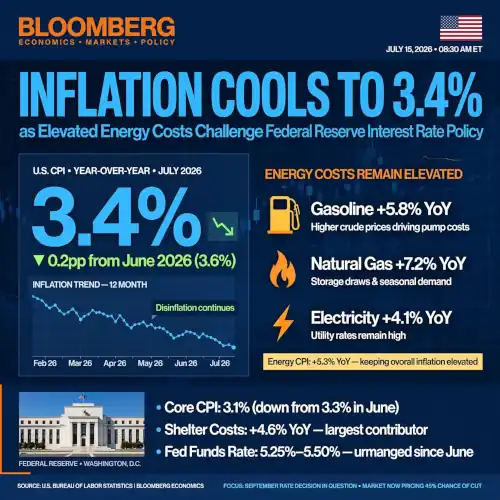

The Bureau of Labour Statistics released its highly anticipated Consumer Price Index report on August 12, 2026, revealing that headline inflation cooled to an annual rate of 3.4% in July. While the modest drop from June’s 3.5% reading signals progress for monetary policymakers, persistent geopolitical friction in the Middle East continues to keep retail fuel and utility costs near record highs. High-energy prices remain a persistent thorn in the side of consumers, even as core price pressures across consumer goods and services begin to moderate.
For Wall Street analysts and central bank officials, the July CPI data offers a nuanced picture of the post-shock economic landscape. Core inflation—which strips out volatile food and fuel categories—eased to 2.5% year-over-year, its lowest level in over two years. However, the broader economic outlook hinges heavily on whether energy market volatility will spill over into transport, manufacturing, and consumer credit markets.
Dissecting the July 2026 CPI Data: Core vs. Headline Inflation Trends
Understanding the split between headline inflation and underlying core metrics is essential for evaluating long-term financial planning and investment strategies. The July CPI report highlighted a clear divergence between sticky shelter costs, elevated energy markets, and cooling consumer goods prices.
July 2026 CPI Inflation Snapshot
├── Headline Annual Inflation: 3.4% (Down from 3.5% in June)
├── Core Annual Inflation (Ex. Food & Energy): 2.5% (Down from 2.6% in June)
├── Monthly CPI Change: +0.1%
├── Monthly Core CPI Change: +0.2%
└── Energy Index Year-Over-Year: +14.7%
Headline Inflation Drops to 3.4% Year-Over-Year
Headline Consumer Price Index growth slowed to 3.4% on an annualized basis in July, matching consensus forecasts across major financial institutions. On a month-over-month basis, consumer prices edged up by just 0.1%, rebounding from a slight 0.4% decline in June.
This cooling trend suggests that the aggressive supply chain bottlenecks seen earlier in the year are slowly untangling. However, consumer purchasing power remains under pressure as cumulative inflation over the past three years keeps baseline expenses elevated.
Core CPI Cools to 2.5%, Signal of Underlying Economic Relief
Core CPI dropped to an annual rate of 2.5% in July, down from 2.6% in June. On a monthly basis, core prices expanded by 0.2%, driven primarily by shelter and medical care services.
Inflation Trajectory Comparison (2026)
May 2026 CPI:  |=========================================> 4.2%
June 2026 CPI: |===================================> 3.5%
July 2026 CPI: |=================================> 3.4%
Target Rate:   |====================> 2.0%
Economists view the steady deceleration in core inflation as a sign that broader service sectors are refusing to pass on secondary price increases. This stabilization provides the Federal Reserve with valuable room to navigate interest rate adjustments without triggering immediate systemic shocks.
Energy Price Pressures: Geopolitical Conflicts and Global Oil Markets
Although overall price growth slowed in July, energy markets remain volatile due to ongoing conflict in Iran and shipping disruptions near the Strait of Hormuz. The broader energy index rose 14.7% year-over-year, reflecting severe structural supply constraints.
Gasoline and Fuel Oil Costs Impact Consumer Budgets
Retail gasoline prices fell 2.9% on a month-over-month basis in July, providing temporary relief at the pump. However, on an annual basis, gasoline costs remain up 24.6%, while fuel oil prices have surged 39.1% over the past 12 months.
-
Gasoline Prices: Down 2.9% month-over-month, but up 24.6% year-over-year.
-
Fuel Oil: Up 39.1% year-over-year due to global crude supply squeezes.
-
Electricity: Up 5.9% annualised as utility providers factor in elevated generation costs.
High energy costs directly affect domestic transportation networks and industrial operations. When freight carriers face higher diesel bills, shipping surcharges inevitably spread to retail store shelves.
Comprehensive Sector-by-Sector CPI Price Breakdown
Analysing granular sectoral data reveals where household budgets face the greatest strain and where price relief is actively materialising.
Detailed CPI Sector Matrix for July 2026
| Sector / Expenditure Category | Monthly Change (MoM) | Annual Change (YoY) | Primary Price Drivers |
| All Items (Headline CPI) | +0.1% | +3.4% | Energy, shelter, and transportation services |
| Core CPI (Ex. Food & Energy) | +0.2% | +2.5% | Housing, medical care, apparel |
| Energy Overall | -0.5% | +14.7% | Crude oil price benchmarks and geopolitical risk premiums |
| Gasoline (All Types) | -2.9% | +24.6% | Seasonal demand shifts offset by foreign supply constraints |
| Shelter / Housing | +0.1% | +3.2% | High mortgage rates slowing housing inventory turnover |
| Food at Home (Groceries) | -0.1% | +2.7% | Lower prices for meat, poultry, and fresh produce |
| Food Away from Home (Restaurants) | +0.3% | +4.1% | Labor expenses and commercial lease costs |
Grocery Prices Decline While Dining Out Costs Rise
Grocery prices fell 0.1% in July, bringing food-at-home annual inflation down to 2.7%. Significant price declines appeared in meats, poultry, fish, and eggs (-0.7%), while lettuce and fresh produce prices fell noticeably.
Conversely, dining out costs rose 0.3% for the month, driven by rising wage requirements and commercial insurance costs across full-service restaurants. This divergence highlights how service-heavy sectors face different inflationary drivers than agricultural commodity markets.
Federal Reserve Rate Decisions and Mortgage Rate Projections
The July inflation report arrives at a critical moment for the Federal Reserve’s Open Market Committee. Central bank officials have kept benchmark interest rates steady throughout 2026 to evaluate whether geopolitical shocks would reignite broad-based inflation.
Federal Reserve Rate Path Options
├── Scenario A: Hold Rates Steady (Evaluate oil volatility & debt liquidity)
└── Scenario B: Rate Cut (Supported by Core CPI cooling to 2.5%)
Will the Fed Cut Interest Rates in Late 2026?
With core CPI settling at 2.5%, probability estimates for a 25-basis-point rate reduction at upcoming policy meetings have increased. Lowering benchmark rates would ease credit costs for small businesses, mortgage borrowers, and automotive consumers.
However, central bankers remain cautious. If Middle Eastern geopolitical risks escalate further, a secondary spike in oil prices could quickly push headline inflation back toward 4%.
Mortgage Rates and Real Estate Market Dynamics
Thirty-year fixed mortgage rates have hovered around elevated levels throughout 2026, stalling home buying activity and suppressing real estate turnover. A sustained drop in headline inflation toward 3% could pull home loan rates down, unlocking pent-up demand in residential real estate markets.
Housing affordability remains constrained because shelter inflation (+3.2% YoY) accounts for nearly two-thirds of total monthly CPI growth. Lower mortgage rates are essential for stimulating new residential construction and increasing available housing inventory.
Strategic Financial Planning Strategies in an Inflationary Climate
Managing household finances and investment portfolios when inflation sits above the 2% target requires proactive balance sheet management.
-
Optimise High-Yield Savings Accounts: Capitalise on elevated interest rates by moving cash reserves into high-yield accounts yielding above 4.5%.
-
Rebalance Energy Sector Exposure: Investors can hedge against geopolitical fuel spikes by allocating a portion of their equity portfolio to energy infrastructure and production stocks.
-
Lock In Fixed Debt Rates: Refinance variable-rate debt into fixed-term instruments before market conditions shift.
-
Monitor Real Wage Growth: Evaluate salary trends against headline CPI (+3.4%) to ensure net purchasing power remains positive.
Frequently Asked Questions (FAQs)
What was the official US inflation rate for July 2026?
The Bureau of Labour Statistics reported that the annualised Consumer Price Index (CPI) increased 3.4% in July 2026, down slightly from 3.5% in June.
What is the difference between headline CPI and core CPI?
Headline CPI measures total price changes across all consumer goods and services, including food and energy. Core CPI excludes volatile food and energy prices to provide a clearer view of long-term economic inflation trends.
Why are energy prices still high despite overall inflation cooling?
Energy prices remain elevated primarily due to geopolitical tensions in the Middle East, including regional military conflicts that restrict crude oil transport through the Strait of Hormuz.
How does the July CPI report impact interest rate decisions?
Because core inflation cooled to 2.5%, the Federal Reserve has greater flexibility to consider interest rate cuts. However, central bankers continue to monitor energy market volatility before finalising policy changes.
Are grocery prices going down in 2026?
Grocery prices (food at home) decreased by 0.1% in July 2026, bringing the annual growth rate down to 2.7%. Prices for meats, poultry, fish, and produce experienced modest price drops.
July’s moderate CPI reading confirms that overall inflationary pressure is gradually subsiding across the domestic economy, even as external energy shocks test market resilience. While elevated fuel and utility bills continue to squeeze household budgets, the broader cooling in core prices provides financial markets and central policymakers with a clearer path toward stability. Navigating these conditions requires maintaining flexible investment allocations, monitoring energy market trends, and adapting personal budgets to high baseline living costs.
To stay informed on financial sector opportunities, job market updates, and career trends, visit USA Free Latest Job Alert. For additional foundational research on macroeconomic indicators and historical monetary trends, explore detailed guides on the Consumer Price Index on Wikipedia and Inflation on Wikipedia.