
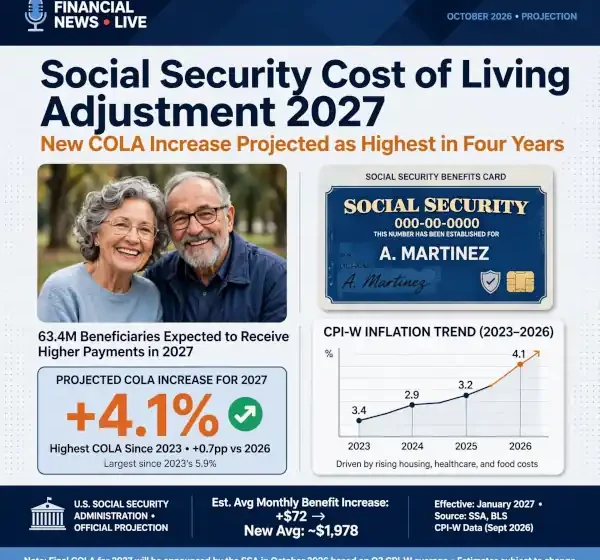

Inflation continues to squeeze household budgets, but millions of American retirees and disabled workers may soon see significant financial relief. Fresh economic data indicates that the 2027 Social Security cost of living adjustment is currently on track to deliver its largest benefit boost in four years.
According to the latest estimates from The Senior Citizens League, the 2027 Social Security COLA projection stands at 3.6%. While this forecast represents a slight dip from last month’s 3.8% projection due to cooling July inflation figures, it remains well above recent annual adjustments.
For millions of seniors relying on fixed retirement incomes, this incoming bump could offer much-needed breathing room against stubborn healthcare costs and elevated grocery bills. Financial planners and beneficiaries alike are watching the Bureau of Labor Statistics data closely as the final determination date approaches.
Consumer Price Index Trends and Social Security Benefit Increase Calculations
The Social Security Administration relies on a specific economic metric to determine annual payment increases. Rather than using the general Consumer Price Index for All Urban Consumers, officials track the Consumer Price Index for Urban Wage Earners and Clerical Workers.
The official COLA calculation takes the average CPI-W reading across the third quarter—specifically July, August, and September—and compares it to the third-quarter average from the previous year. The Bureau of Labor Statistics reported that the July CPI-W rose 3.4% year-over-year.
Because the adjustment depends on a three-month average, the upcoming inflation reports for August and September will directly dictate the final payout boost. The SSA will officially announce the finalized 2027 COLA on October 14, with the updated benefit checks arriving in January.
Key factors currently shaping the 2027 Social Security payout boost include:
-
Energy Market Volatility: Oil prices have fluctuated sharply, directly impacting transportation and shipping costs across consumer goods.
-
Sticky Service Inflation: Medical services, outpatient care, and home insurance premiums continue to outpace headline inflation figures.
-
Cooling Core Inflation: Lower prices on prescription drugs and select durable goods have helped keep overall inflation from spiking further.
-
Federal Reserve Monetary Policy: Interest rate decisions continue to influence consumer borrowing costs and overall economic growth.
Historical Social Security COLA Comparison and Monthly Payout Projections
To understand the magnitude of the projected 3.6% bump, it helps to examine historical Social Security adjustment data over the past several years. During the height of pandemic-driven inflation in 2023, beneficiaries received a historic 8.7% increase.
As inflation moderated over subsequent years, COLA figures naturally drifted back toward historical averages. The 2024 adjustment landed at 3.2%, followed by 2.5% in 2025 and 2.8% in 2026.
If The Senior Citizens League’s 3.6% forecast holds true, the average monthly benefit for retired workers will rise by approximately $69.75 per month. This would elevate average monthly payments from $1,937.53 to $2,007.28 starting in January.
| Calendar Year | Official COLA Percentage | Average Monthly Payout Increase | Key Economic Drivers |
| 2023 | 8.7% | $146.00 | Pandemic supply chain shocks & fuel spikes |
| 2024 | 3.2% | $59.00 | Moderate wage growth & stabilizing gas prices |
| 2025 | 2.5% | $48.00 | Cooling consumer demand & interest rate hikes |
| 2026 | 2.8% | $54.00 | Persistent shelter & service inflation |
| 2027 (Projected) | 3.6% | $69.75 | Rebounding shelter, energy, & healthcare expenses |
Independent analysts from AARP project a slightly more conservative 3.5% adjustment, which would still yield an average monthly raise of roughly $73.00. Regardless of whether the final figure lands at 3.5% or 3.6%, beneficiaries can expect their largest payment increase since 2023.
Senior Financial Planning Strategies and COLA Discrepancies
While a 3.6% increase provides welcome revenue, consumer advocates frequently point out a fundamental structural flaw in how Social Security adjustments are calculated. The CPI-W measures the spending habits of younger working adults rather than older retirees.
Seniors allocate a significantly larger portion of their monthly budget to healthcare, prescription medications, and housing—categories where price increases routinely exceed general inflation. As a result, many retirees feel that annual COLAs fail to fully preserve their real purchasing power.
To stretch monthly Social Security income and mitigate rising living expenses, financial advisors recommend several proactive steps:
-
Audit Healthcare Coverage: Review Medicare Advantage and Part D plans during annual enrollment to minimize out-of-pocket medical expenses.
-
Account for Tax Brackets: Remember that up to 85% of Social Security benefits become taxable if your combined income exceeds federal thresholds.
-
Delay Claiming Benefits: If you have not yet filed, waiting past Full Retirement Age increases your baseline monthly payout by 8% per year up to age 70.
-
Build an Inflation Buffer: Maintain a liquid emergency savings account yielding competitive interest to cover unexpected medical or home repair costs.
Frequently Asked Questions Regarding the 2027 Social Security COLA
When will the Social Security Administration announce the official 2027 COLA?
The SSA will publish the official 2027 COLA rate on October 14, following the release of the September CPI-W report by the Bureau of Labor Statistics.
When will beneficiaries see the 2027 payment increase in their checks?
The cost of living adjustment takes effect with payments distributed in January. Supplemental Security Income recipients will receive their updated payments on the final business day of December.
How much will the average Social Security payment increase in 2027?
Based on the current 3.6% projection, average monthly retiree benefits will increase by $69.75, moving from $1,937.53 to $2,007.28.
Will Medicare Part B premiums reduce the net Social Security increase?
Yes, Medicare Part B premiums are automatically deducted from monthly Social Security payments for most retirees. If Medicare Part B premiums rise in 2027, that increase will offset a portion of your net COLA raise.
How does Social Security fast-track disability benefits for eligible applicants?
The SSA maintains a Compassionate Allowances program that automatically identifies severe medical conditions, allowing qualifying disability applicants to receive expedited approval without months of administrative waiting.
Actionable Takeaways for Maximizing Your Social Security Retirement Income
Navigating retirement finances requires staying informed about shifting economic data and policy updates. While the projected 3.6% COLA represents a substantial boost for fixed-income households, relying solely on annual adjustments is rarely enough to beat long-term inflation. Take time this fall to review your overall financial plan, optimize your Medicare coverage, and ensure your monthly budget accounts for potential tax impacts on your higher benefit checks.
Community Discussion & Verification Resources:
-
Join the active community debate on Job Alerts Google Search to discuss retirement benefit strategies and updates.
-
Share your thoughts on inflation and retirement planning at the NT Live News Community Forums.
-
Review official historical data and policy guidelines at the Social Security Administration Wikipedia Entry and the official U.S. Social Security Administration Website.