
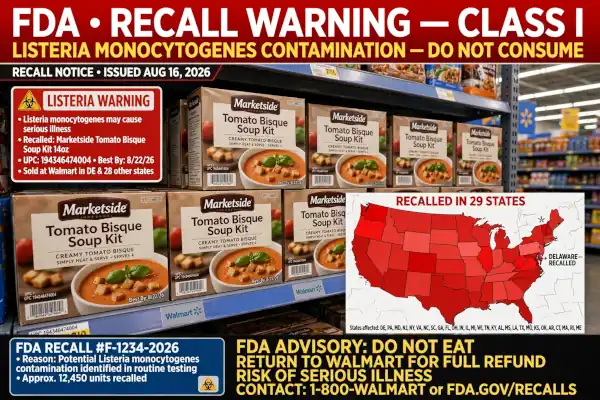
Listeria Warning at Walmart: Thousands of Tomato Bisque Soup Kits Recalled Across Delaware and 28 Other States

Federal food safety regulators and public health officials have issued an urgent warning to consumers after Maryland-based manufacturer Kettle Cuisine LLC initiated a voluntary recall of more than 3,000 packaged soup kits sold exclusively at Walmart retail locations. The alert, published in coordination with the U.S. Food and Drug Administration (FDA), stems from internal quality control screenings that detected the potential presence of Listeria monocytogenes—a dangerous, cold-tolerant bacterial pathogen capable of causing severe and potentially fatal infections.
The nationwide safety action affects 3,240 individual packages of Marketside Tomato Bisque Soup Kits distributed across 29 states, including Delaware, Maryland, New Jersey, Pennsylvania, New York, Texas, and California. Because these refrigerated soup kits carry an expiration date extending through late August 2026, health authorities are cautioning that contaminated containers may still be sitting on consumer refrigerator shelves across the country.
Overview of the Recalled Product
The recall applies specifically to 14-ounce (397g) wrapped tray meal kits sold under Walmart’s private-label fresh foods brand, Marketside. Consumers can verify whether their purchase is subject to the recall by inspecting the printed product description label and barcode on the exterior packaging:
| Product Detail | Specific Identifier |
| Brand Name | Marketside |
| Product Description | Tomato Bisque Soup Kit |
| Package Size | 14 oz (397g) wrapped tray |
| UPC Barcode | 194346474004 |
| Use-By / Expiration Date | August 22, 2026 (8/22/26) |
| Manufacturer | Kettle Cuisine LLC (Savage, MD) |
| Total Units Recalled | 3,240 packs |
| Distribution Window | Shipped between June 30, 2026, and July 7, 2026 |
The FDA confirmed that Kettle Cuisine launched the proactive market withdrawal after routine microbiological surveillance testing conducted at its Savage, Maryland processing facility returned a presumptive positive result for Listeria monocytogenes.Rather than waiting for secondary laboratory confirmation, the company initiated the recall immediately to protect consumers from exposure.To date, no confirmed illnesses, adverse medical events, or hospitalizations have been reported in connection with the soup kits.
Geographic Footprint: 29 Impacted States
The affected batches were distributed exclusively to select Walmart supercenters and grocery locations across the East Coast, Midwest, South, and Western regions.
The full list of 29 states where the recalled Marketside soup kits were delivered includes:
- Mid-Atlantic & Northeast:Delaware, Maryland, New Jersey, New York, Pennsylvania, Connecticut, Vermont.
- South & Southeast:Arkansas, Georgia, Louisiana, Mississippi, North Carolina, Virginia, West Virginia.
- Midwest & Great Lakes:Illinois, Indiana, Iowa, Kansas, Kentucky, Missouri, Ohio, Wisconsin.
- Southwest & West:California, Colorado, Nevada, New Mexico, Oklahoma, Oregon, Texas.
Walmart stores in these jurisdictions have been instructed to remove any remaining inventory from refrigerated display cases and secure supply rooms for proper destruction.
Why Listeria Poses a Hidden Refrigeration Hazard
Listeria monocytogenes is widely regarded by microbiologists and food safety experts as one of the most persistent foodborne pathogens in commercial food manufacturing.
Unlike common bacteria such as Salmonella, E. coli, or Campylobacter, which thrive in warm conditions and are inhibited by low temperatures, Listeria is a psychrotolerant organism. This means it can survive, adapt, and continue to slowly replicate at standard household refrigerator temperatures (between 35°F and 40°F / 1.6°C and 4.4°C).
Because the recalled tomato bisque soup kits carry an expiration date of August 22, 2026, products bought weeks ago and kept refrigerated may have provided the bacteria with ample time to multiply if oocysts or bacterial cells were present.
Crucially, foods contaminated with Listeria do not exhibit the typical signs of spoilage.The soup will not smell sour, appear cloudy, change color, or taste off.Consumers cannot rely on sensory checks—such as smelling or tasting a spoonful—to determine whether the product is safe to consume.
Symptoms and High-Risk Populations
Ingesting food contaminated with Listeria can lead to listeriosis, an invasive and serious bacterial illness.While healthy adults exposed to low levels of the bacteria may experience only mild, transient discomfort, the pathogen poses life-threatening hazards to vulnerable groups:
- Pregnant Individuals:Listeria presents a grave danger during pregnancy.Expectant mothers may experience mild, nonspecific flu-like symptoms such as fatigue, muscle aches, or low-grade fever.However, the bacteria can readily penetrate the placental barrier, leading to catastrophic complications including spontaneous miscarriage, premature labor, stillbirth, or systemic neonatal infection.
- Adults Aged 65 and Older: As the human immune system ages, its cell-mediated defenses weaken, making older adults significantly more susceptible to invasive bloodstream infections (bacteremia) and brain infections (listerial meningitis).
- Immunocompromised Individuals:Patients undergoing chemotherapy, individuals taking immunosuppressive therapies, organ transplant recipients, and those living with chronic renal or hepatic failure face elevated risks of severe morbidity and mortality.
In non-invasive presentations, symptoms typically begin within a few days of consumption and include nausea, persistent diarrhea, abdominal cramping, and fever.
In invasive cases, however, Listeria can migrate into the central nervous system and bloodstream, presenting with high fever, severe muscle stiffness, debilitating headaches, loss of balance, confusion, and convulsions.Because the incubation period for listeriosis can extend up to 70 days, individuals who consumed the soup weeks ago must remain vigilant for emerging symptoms.
Essential Precautions: Action Plan for Consumers
If you live in Delaware or any of the other 28 affected states and regularly purchase prepared meals from Walmart, public health officials recommend following these actionable protocols immediately:
- Check Your Refrigerator and Freezer: Inspect all ready-to-eat soup kits. Match the label against the UPC code (194346474004) and verify the expiration date (8/22/26).
- Do Not Consume or Taste:If you identify a recalled tray, do not eat, serve, or sample the product.Place the container inside a sealed plastic grocery bag before discarding it in an outdoor trash receptacle to prevent pets or wildlife from accessing it.Alternatively, return the unopened or opened kit to your local Walmart customer service counter for a full refund.
- Thoroughly Sanitize Surfaces: Because Listeria spreads easily to other foods and surfaces, wash your hands thoroughly with warm water and soap for at least 20 seconds after handling the packaging. Clean and disinfect all refrigerator drawers, shelves, cutting boards, and utensils that came into contact with the soup tray using a mild bleach-and-water solution or antibacterial kitchen spray.
- Consult Healthcare Providers:If you or a family member consumed the recalled Marketside Tomato Bisque Soup Kit and experience unexplained fever, muscle aches, neck stiffness, or gastrointestinal distress, seek medical evaluation promptly and inform your clinician of the possible Listeria exposure.
Kettle Cuisine and the FDA continue to review manufacturing logs, equipment sanitation cycles, and environmental swabs to ensure all facility lines meet federal safety standards before resuming regular distribution.