
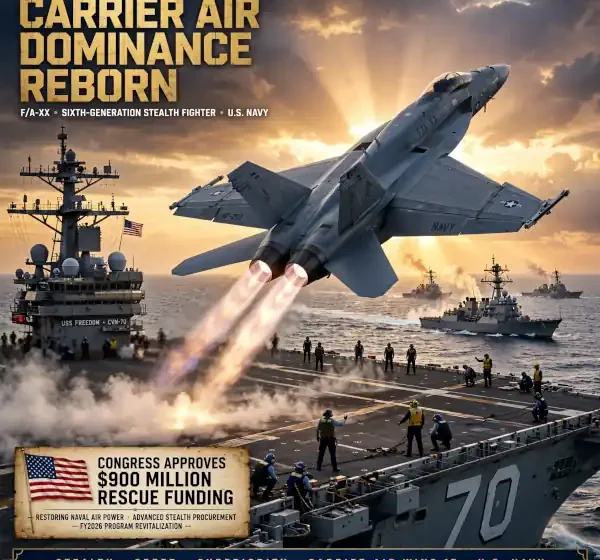
Carrier Air Dominance Reborn: Inside Congress’s $900 Million Rescue of the Navy’s F/A-XX Sixth-Generation Stealth Fighter

WASHINGTON — In one of the most dramatic defense budget interventions on Capitol Hill in recent history, United States lawmakers have moved aggressively to overturn the Pentagon’s decision to sideline the U.S. Navy’s sixth-generation carrier-based fighter program. Facing an executive budget proposal that would have gutted the F/A-XX program down to a skeletal holding pattern, Congress stepped in with a massive financial injection—multiplying the fighter’s research and development funding 13-fold by adding $897 million back into the procurement pipeline.
The legislative intervention catapults the F/A-XX budget from an austerity-level $74 million request to over $971 million, clearing the runway for an accelerated prime contractor down-select between aerospace giants Boeing and Northrop Grumman.
The Near-Death Experience of the F/A-XX
While the U.S. Air Force’s Next Generation Air Dominance (NGAD) initiative and its flagship platform have dominated defense headlines, the Navy’s carrier-capable counterpart was quietly on the chopping block.
Under the original 2027 Department of the Navy budget request formulated under former Navy Secretary John Phelan, F/A-XX development funding was slashed by 84%, plunging from planned multi-hundred-million-dollar allocations to just $74 million. Navy leadership had sought to prioritize immediate surface shipbuilding, fleet expansion, and submarine construction over next-generation combat airframes.
To naval aviators and defense strategists, the proposed deferral threatened to open a dangerous capability gap aboard American aircraft carriers. The Navy’s current workhorses, the F/A-18E/F Super Hornet and the F-35C Lightning II, face expanding anti-access/area-denial (A2/AD) missile umbrellas deployed by peer adversaries across the Western Pacific. Without a longer-range, broadband-stealth strike fighter, carrier strike groups risk being pushed beyond operational striking distance of hostile coastlines.
Recognizing that stalling development would forfeit crucial engineering momentum, defense committees on Capitol Hill acted decisively during authorization markups to restore the program’s full development pace.
| Program Metric | Initial Navy FY2027 Request | Congressional Mark | Net Change |
| F/A-XX R&D Budget | $74 Million | $971+ Million | +$897 Million (13.1x increase) |
| Primary Competitors | Boeing, Northrop Grumman | Boeing, Northrop Grumman | Down-select accelerated |
| Primary Strategic Theater | Indo-Pacific / First Island Chain | Indo-Pacific / First Island Chain | Operational continuity preserved |
Pentagon Leadership Shakeups and a Record $377B Budget
The congressional budget battle took place amid major leadership turbulence inside the Pentagon.
The funding proposal was part of a record-breaking $377 billion Department of the Navy 2027 budget request—the largest in naval history, marking a 23% surge over 2026 figures. However, the release of the proposal coincided with the abrupt dismissal of Navy Secretary John Phelan following reported policy disputes with Defense Secretary Pete Hegseth.
The sudden leadership vacancy forced Acting Secretary of the Navy Hung Cao to defend the record request before Congress with less than a month in his role. Appearing alongside Chief of Naval Operations Admiral Daryl Caudle and Marine Corps Commandant General Eric Smith, Cao outlined a strategic focus centered on increasing absolute hull counts and building a lethal combat force.
Yet, while lawmakers concurred with the imperative to address China’s expanding maritime footprint, they pushed back hard against gutting naval aviation to fund ship hulls constrained by severe shipyard bottlenecks.
                    ┌──────────────────────────────────────────────┐
                    │      Congressional Budget Reallocation       │
                    └──────────────────────┬───────────────────────┘
                                           │
         ┌─────────────────────────────────┴─────────────────────────────────┐
         ▼                                                                   ▼
[Source of Funds]                                                  [Destination of Funds]
• Redirection from Submarine Yard Automation (~$900M)              • F/A-XX 6th-Gen Fighter ($971M+)
• Divestment / Early Retirement of Legacy Hulls/Airframes          • Long-Range Broadband Stealth Maturation
• R&D Reprogramming from Bottlenecked Shipbuilding Pipelines       • Collaborative Combat Aircraft (CCA) Teaming
Tracking the $900 Million Reallocation
Because federal appropriations operate within statutory spending caps, injecting nearly $900 million into an aviation line item required substantial offsets across the naval ledger.
While Congress did not release an itemized transfer ledger, defense budget analysts note clear alignment with planned reductions elsewhere:
- Submarine Industrial Base Automation: Former Secretary Phelan had championed an estimated $900 million automation and tooling modernization initiative for Virginia-class submarine shipyards. With domestic yards already facing labor and throughput bottlenecks, lawmakers redirected those capital improvement reserves into immediate aerospace engineering lines.
- Legacy Platform Retirements: Additional funds were recaptured by retiring select legacy surface combatants and older aircraft early, shifting sustainment funding directly into sixth-generation research.
The Contractor Showdown: Boeing vs. Northrop Grumman
With capital secured, the Navy is set to move forward with a formal down-select between Boeing and Northrop Grumman to design and manufacture the first operational sixth-generation naval fighter.
The competition brings distinct industrial dynamics into sharp focus:
- Northrop Grumman’s Procurement Momentum: Northrop Grumman enters the arena backed by its performance on the Air Force’s B-21 Raider sixth-generation stealth bomber—widely praised as a rare on-schedule, on-budget defense acquisition success. Northrop also brings deep carrier heritage, stretching from the F-14 Tomcat to the experimental X-47B unmanned carrier demonstrator.
- Boeing’s Engineering Challenge: Boeing secured the manufacturing contract for the Air Force’s NGAD tactical airframe, but the company has grappled with defense production backlogs in recent years. While developing a naval variant of its land-based architecture is technically viable, marinizing a high-performance stealth fighter—beefing up landing gear for catapult launches, reinforcing tailhook arrestment bulkheads, and applying salt-corrosion-resistant low-observable coatings—involves extensive redesign, leaving an opening for Northrop Grumman’s clean-sheet naval concept.
Pivoting to the Pacific: Range, Stealth, and Uncrewed Teaming
The strategic rationale behind the F/A-XX centers squarely on the vast distances and defensive densities of the Indo-Pacific theater.
Current carrier air wings rely on the F/A-18E/F and F-35C, both of which operate with an unrefueled combat radius of roughly 600 nautical miles (1,100 km). In a contested Indo-Pacific scenario, Chinese anti-ship ballistic missiles such as the DF-21D and DF-26 threaten carriers operating inside the second island chain, creating an operational standoff.
The F/A-XX is purpose-built to break this dilemma:
- Over 125% Range Increase: Drawing on statements from Rear Admiral Michael “Buzz” Donnelly, former director of the Air Warfare Division, the F/A-XX will deliver “over 125 percent of the range” of current fighters. Analysts project an unrefueled combat radius between 750 nautical miles (1,220 km) and 1,250 nautical miles (1,930 km), enabling carrier strike groups to launch strikes from outside adversary missile kill zones.
- Multispectral Stealth: Tailored with tailless or low-profile planforms to evade both high-frequency fire-control radars and low-frequency early-warning radar arrays.
- Collaborative Combat Aircraft (CCA) Integration: Operating as a central airborne battle manager, the crewed F/A-XX will coordinate autonomous uncrewed wingmen for forward sensing, electronic warfare jamming, and standoff missile delivery.
By overriding the Navy’s proposed deferral and authorizing a $971 million program baseline, Congress reaffirmed that future American sea power depends on pairing carrier hulls with long-range sixth-generation air dominance.