
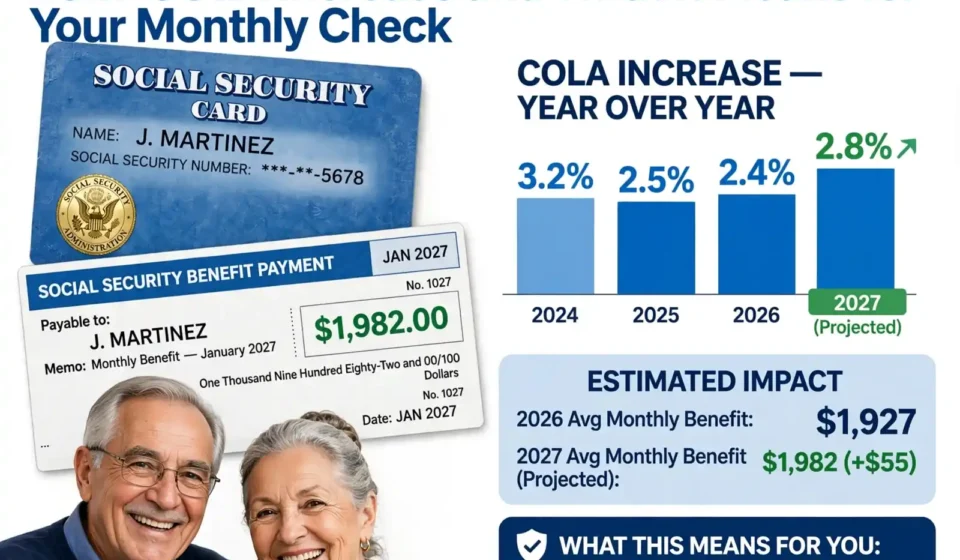

Business and Finance: Millions of American retirees, disability recipients, and surviving family members rely on Social Security to maintain their quality of life. As inflation fluctuates, every dollar counts. With costs creeping upward on essentials like food, shelter, and medical care, beneficiaries are turning their attention toward the upcoming Social Security adjustment.
Following the 2.8% boost applied in 2026, initial estimates and economic data for the 2027 COLA increase point to an even higher potential adjustment. Understanding 2027 What the Social Security COLA means for your benefits can help you plan your household budget, optimise your healthcare choices, and build a resilient retirement strategy.
What Is the Social Security Cost-of-Living Adjustment (COLA)?
The Cost-of-Living Adjustment (COLA) is an annual mechanism created by Congress in 1975 to prevent inflation from eroding the purchasing power of Social Security and Supplemental Security Income (SSI) payments.
When general market prices rise, the Social Security Administration (SSA) increases monthly payments to match that inflation rate. When inflation stalls or turns negative, payments remain unchanged; Social Security benefits do not drop when prices deflate.
          [July, Aug, Sept CPI-W Data]
                       │
                       ▼
         [SSA Calculates Average Shift]
                       │
                       ▼
       [Official Announcement in October]
                       │
                       ▼
     [Updated Checks Arrive the Following Jan]
Social Security 2027 COLA Increase: Real Data and Key Projections
After receiving a 2.8% bump in 2026, beneficiaries are on track for a noticeable increase in 2027. According to analyses by independent policy groups and nonpartisan advocacy organisations like The Senior Citizens League (TSCL), the current forecast projects a 3.7% to 3.8% COLA boost for 2027.
┌──────────────────────────────────────┬────────────────────────────┐
│ Indicator / Metric                   │ Figures & Projections      │
├──────────────────────────────────────┼────────────────────────────┤
│ 2026 COLA Baseline                   │ 2.8%                       │
│ Projected 2027 COLA Range            │ 3.7% – 3.8%                │
│ Current Average Monthly Benefit      │ ~$2,026.00                 │
│ Projected Monthly Dollar Bump        │ ~$73.62 – $79.14           │
│ Projected New Average Monthly Benefit│ ~$2,103.41 – $2,161.90     │
└──────────────────────────────────────┴────────────────────────────┘
(Sources: Social Security Administration Statistical Snapshots, TSCL Forecasts)
How This Adjustment Translates to Your Monthly Check
For the typical retired worker receiving around $2,026 per month, a 3.8% increase adds approximately $77.00 to $79.00 each month. Couples who both receive Social Security could see their combined benefit increase by $150 or more per month.
While a $77 monthly increase offers welcome financial relief, many advocates emphasise that persistent structural inflation—particularly in fuel, housing, and healthcare—continues to strain fixed-income budgets.
How the Social Security Administration Calculates Your Raise
The SSA does not arbitrarily pick COLA percentages. Federal law dictates that the agency calculate the adjustment using a specific consumer price index: the Consumer Price Index for Urban Wage Earners and Clerical Workers (CPI-W), managed by the U.S. Bureau of Labour Statistics (BLS).
The Step-by-Step COLA Timeline
-
Third-Quarter Measurement: The BLS tracks CPI-W figures specifically across July, August, and September.
-
Year-over-Year Comparison: The SSA calculates the average CPI-W index for these three months and compares it directly against the average from the same three months of the prior year.
-
October Announcement: In mid-October, the government releases the official percentage increase.
-
January Implementation: The revised payment amounts take effect starting with checks issued in January of the new year.
Because the official percentage depends exclusively on third-quarter data, mid-year projections remain estimates until September’s inflation metrics are finalised.
Why Advocates Push for Formula Reform: CPI-W vs. CPI-E
A major ongoing debate surrounding the upcoming Social Security adjustment focuses on how the government measures inflation for older Americans.
   CPI-W (Current Index)               CPI-E (Proposed Senior Index)
  ┌───────────────────────┐           ┌───────────────────────┐
  │ Working Professionals │           │ Retirees & Seniors    │
  │ • Higher Urban Weight │           │ • Higher Health Weight│
  │ • Gas & Transit focus │           │ • Housing & Rx focus  │
  └───────────────────────┘           └───────────────────────┘
The Flaw in the CPI-W Formula
The CPI-W measures the spending patterns of younger working urban employees. Working Americans spend a larger share of their income on transportation, clothing, and broad consumer goods.
In contrast, retirees spend a far larger percentage of their income on healthcare, prescription drugs, and housing—categories where prices typically rise faster than general consumer goods.
The Proposed Alternative: CPI-E
Senior groups like AARP and The Senior Citizens League urge lawmakers to adopt the Consumer Price Index for the Elderly (CPI-E).
-
Higher Weight on Healthcare: The CPI-E gives significantly heavier weight to out-of-pocket medical expenses and prescription drugs.
-
Real Purchasing Power: Research shows that switching to the CPI-E would have added roughly 0.2 percentage points per year to historical COLAs, accumulating substantial additional income over a multi-decade retirement.
2027 What the Social Security COLA Means for Your Benefits and Medicare Premiums
When analysing any Social Security 2027 COLA increase, you must account for Medicare Part B deductions. For most seniors, Medicare Part B premiums are automatically deducted directly from their monthly Social Security benefit check.
  Gross Social Security Increase
  − Medicare Part B Premium Hike
  ───────────────────────────────
  = Net Cash Improvement
When Medicare Part B premiums rise alongside general healthcare inflation, they absorb a portion of your annual Social Security adjustment.
If your gross Social Security check rises by $77 per month, but Medicare Part B premiums increase by $10 to $15, your net cash gain equals roughly $62 to $67 per month. Accounting for this net metric prevents unexpected cash-flow gaps when updating your annual household budget.
Smart Strategies to Maximise Your Social Security Benefits
Whether you already receive benefits or plan to claim soon, strategic planning helps you optimise your income regardless of shifting inflation targets:
-
Delay Claiming Until Full Retirement Age (FRA) or Beyond:
Claiming benefits before your Full Retirement Age (typically 66 to 67) permanently reduces your monthly benefit amount. Delaying benefits past your FRA adds an 8% simple interest increase to your monthly benefit for every year you wait, up to age 70.
-
Coordinate Spousal Benefits:
Married couples can optimise lifetime payouts by having the higher-earning spouse delay claims to build a larger base benefit, which also locks in higher cost-of-living adjustments for both partners over time.
-
Manage Retirement Tax Drag:
Up to 85% of your Social Security benefit may become subject to federal income tax if your combined income exceeds specific thresholds ($25,000 for individual filers or $32,000 for joint filers). Drawing strategically from Roth accounts or traditional IRAs can help manage your taxable bracket.
Looking Ahead to the October COLA Announcement
The upcoming social security adjustment offers vital relief as inflation affects everyday expenses. While current estimates project a 3.7% to 3.8% increase for 2027, the official number will be locked in when the BLS releases late-summer inflation figures in October.
By tracking these updates, understanding Medicare deductions, and planning your retirement cash flows proactively, you can ensure your long-term financial security stays on track.