
Federal courts have delivered a series of landmark decisions that directly impact federal student aid, higher education governance, and civil rights enforcement. A major Department of Education lawsuit ruling alongside parallel federal court decisions has struck down administrative restrictions on student loan forgiveness, narrowed definitions for graduate loan limits, and blocked federal funding cuts to school mental health initiatives.
For millions of student loan borrowers, public service workers, university administrators, and educational leaders, these legal rulings fundamentally alter how financial aid is administered, how public service eligibility is evaluated, and how institutional funding is protected.
This news report and step-by-step action guide breaks down what happened in court, what these decisions mean for you, and how to navigate the immediate path forward.
What the Federal Courts Decided
The recent legal battleground centres on the boundaries of executive authority under the Administrative Procedure Act (APA) and federal education statutes. In recent rulings, federal judges ruled that the U.S. Department of Education (ED) exceeded its statutory power by introducing restrictive rules without explicit congressional approval or proper public comment procedures.
                        FEDERAL COURT RULINGS AT A GLANCE
┌──────────────────────────────┬─────────────────────────────┬───────────────────────────────┐
│ Action / Program             │ Court Decision              │ Primary Impact                │
├──────────────────────────────┼─────────────────────────────┼───────────────────────────────┤
│ Public Service Loan          │ Final Rule Vacated          │ Nonprofits retain eligibility │
│ Forgiveness (PSLF)           │ Nationwide                  │ without subjective agency     │
│                              │                             │ disqualification│
├──────────────────────────────┼─────────────────────────────┼───────────────────────────────┤
│ Graduate Professional        │ Implementation Stayed       │ Broader loan limit            │
│ Degree Definitions           │ Nationwide                  │ categories remain protected   │
│                              │                             │ pending trial   │
├──────────────────────────────┼─────────────────────────────┼───────────────────────────────┤
│ School Mental Health         │ Injunction Granted          │ Federal grant dollars flow to │
│ Grant Funding                │ Against ED Cuts             │ local K-12 districts│
└──────────────────────────────┴─────────────────────────────┴───────────────────────────────┘
The Public Service Loan Forgiveness (PSLF) Rule Vacated
Two federal court decisions vacated the Department of Education’s proposed Final Rule on the Public Service Loan Forgiveness (PSLF) program. The challenged regulation sought to give the agency authority to disqualify 501(c)(3) non-profit employers if the agency deemed them to be engaged in activities with a “substantial illegal purpose”.
Federal judges ruled that the Department created new definitions and imposed employer burdens well beyond the scope of the Higher Education Act as intended by Congress. As a result, non-profit eligibility criteria revert to objective statutory standards.
Preliminary Injunction on Graduate “Professional Degree” Loan Limits
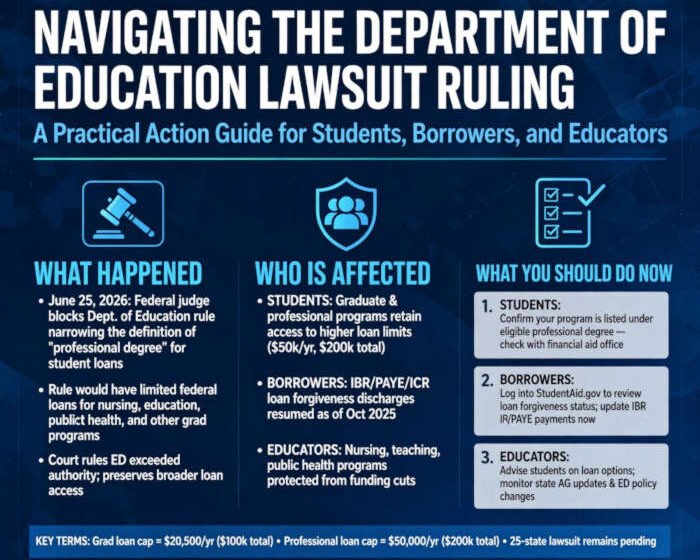
In American Association of Nurse Practitioners v. McMahon, the U.S. District Court for the District of Columbia stayed the Department’s attempt to narrow the regulatory definition of a “professional degree”.
Under recent tax and education legislation, students in recognised professional degree programs have access to higher federal loan caps. The Department attempted to restrict this definition to a narrow set of traditional fields, potentially cutting off advanced nursing, mental health, and therapy students from vital graduate aid. The federal court order paused this restriction nationwide.
Federal Injunction Blocking Mental Health Grant Cuts
A coalition of state attorneys general secured court orders blocking the federal government from prematurely terminating millions of dollars in school-based mental health grants. The court found the Department’s unilateral grant discontinuations unlawful and issued permanent injunctive relief preventing administrative cuts without due process.
Why the Department of Education Lawsuit Ruling Matters to You
These judicial interventions carry real-world consequences for three major groups:
-
Public Service Workers (Teachers, Nurses, Non-Profit Staff): Protects your track toward 10-year loan forgiveness by preventing retroactive employer disqualification.
-
Graduate & Professional Students: Preserves access to federal direct unsubsidized and Grad PLUS lending thresholds for specialised health and advanced degree programs.
-
School Districts & Universities: Restores administrative certainty, protecting federal grant pipelines and preventing emergency operational cutbacks.
How-To Guide: How to Respond to the Department of Education Lawsuit Ruling
Whether you are an individual borrower managing student loans or a financial aid administrator planning institutional budgets, proactive steps are essential.
Phase 1: For Public Service Loan Forgiveness (PSLF) Applicants
Phase 2: For Graduate Students & Financial Aid Applicants
If you are enrolled in or applying for graduate studies in nursing, physician assistant studies, therapy, or mental health counselling, the court’s stay on loan limits provides immediate stability.
-
Verify Award Letters with Your Financial Aid Office:
-
Reach out directly to your university’s financial aid department to confirm whether your program is currently certified for professional student loan limits under the court’s stay.
-
-
Review FAFSA & Master Promissory Notes (MPN):
-
Ensure your FAFSA forms reflect your current graduate degree classification. Do not accept private student loans with high interest rates before confirming full federal borrowing eligibility.
-
-
Monitor Official Department Guidance Updates:
-
While the district court stayed the narrowed rule, the Department must issue further implementation notices. Sign up for updates on StudentAid.gov to receive regulatory changes directly.
-
Comparative Analysis: What Changed Before vs. After the Ruling
To help digest the practical effects of the Department of Education lawsuit ruling, the table below compares previous administrative proposals with the current status mandated by federal courts:
| Area of Education Policy | Proposed Administrative Directive | Current Post-Ruling Status |
| PSLF Employer Eligibility | The department could disqualify non-profits for “illegal purpose”. | Vacated Nationwide. Standard statutory 501(c)(3) criteria apply. |
| Graduate Loan Caps | Narrowed the “professional degree” definition, cutting health fields. | Stayed Nationwide. Previous broad degree fields remain eligible. |
| School Mental Health Grants | Early termination of federal district funding allocations. | Injunction Granted. Grants remain funded and operational. |
| DEI Enforcement Directives | Threats to withhold federal aid via informal letters. | Invalidated. ED dropped the appeal; formal APA procedures required. |
Action Plan for Educational Administrators & Policy Officials
If you manage higher education financial aid or K-12 federal grant allocations, take these immediate operational actions:
-
Maintain Standard PSLF Processing: Do not alter how your human resources department certifies employee signatures for public service workers.
-
Freeze Arbitrary Funding Reallocations: Ensure that grant-funded personnel—specifically in student mental health and counselling—remain onboarded under protected federal funding pools.
-
Consult Legal Counsel on Regulatory Compliance: Because courts held that informal “Dear Colleague” guidance letters cannot override formal rulemaking laws, wait for official Federal Register postings before altering institutional policies.
Conclusion
The latest court decisions reinforce a crucial principle: administrative agencies must operate strictly within the boundaries established by Congress and follow procedural law.
-
Your PSLF eligibility remains safe under standard non-profit rules.
-
Graduate student borrowing options remain active for advanced healthcare and specialised fields.
-
Federal education grants continue flowing to public schools and community programs.
Stay proactive by maintaining clear digital records of your student loans and consulting with your institution’s financial aid advisors to navigate future regulatory updates smoothly.