
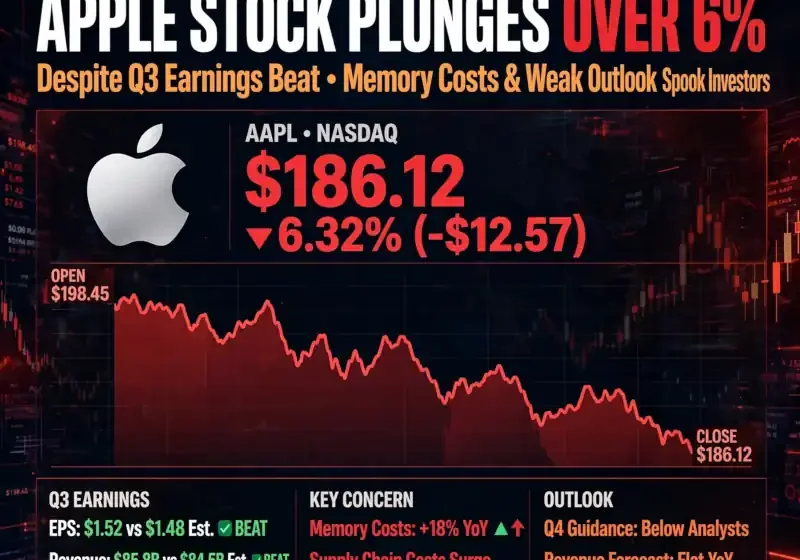
Apple Stock Plunges Over 6% Despite Q3 Earnings Beat: Memory Costs and Weak Outlook Spook Investors

On Thursday, Apple Inc. reported its financial results for the fiscal third quarter of 2026. While the tech giant posted stronger-than-expected revenue and earnings, its stock price tumbled more than 6% in after-hours trading. The culprit? A weaker-than-anticipated outlook for the upcoming September quarter, driven by severe supply chain constraints and skyrocketing memory-chip costs.
Apple’s fiscal Q3 2026 results appeared robust at first glance. The company posted quarterly revenue of $109.42 billion, a 16% increase year-over-year, edging past Wall Street’s consensus estimate of approximately $108.9 billion.
Earnings per share (EPS) surged 29% to $2.02, handily beating the $1.89 forecast.
| Metric | Q3 2026 Actual | Wall Street Estimate | Year-Over-Year Growth |
| Total Revenue | $109.42 billion | ~$108.9 billion | +16% |
| Earnings Per Share (EPS) | $2.02 | $1.89 | +29% |
| iPhone Revenue | $54.25 billion | $53.86 billion | +21.7% |
| Mac Revenue | $10.35 billion | $8.74 billion | +28.7% |
| Services Revenue | $30.74 billion | $31.22 billion | +12.7% |
| iPad Revenue | $6.19 billion | $6.92 billion | -5.9% |
While product sales—particularly the iPhone and Mac—showed exceptional strength, the Services division saw a slight deceleration in growth. Services revenue reached $30.74 billion, which was slightly below the $31.22 billion analysts had modeled. Despite the miss, a 12.7% year-over-year growth rate for Services marks the 12th consecutive quarter of double-digit expansion for the highly profitable segment.
Weak Guidance and the “Hundred-Year Flood”
Despite the top-line success, investors quickly focused on the company’s near-term forecast. Chief Financial Officer Kevan Parekh guided for September-quarter revenue growth of 9% to 11%, falling short of the 12% expansion that analysts had anticipated.
The primary driver behind this tempered outlook is a crippling global memory-chip shortage. During the earnings call, CEO Tim Cook bluntly described the memory crunch as a “hundred-year flood,” noting that companies are aggressively scrambling to secure chip manufacturing capacity amid the ongoing artificial intelligence boom. These supply constraints are severely limiting Apple’s ability to meet the “incredibly strong demand” for its iPhone, iPad, and Mac lineups.
Margin Pressures and the Tariffs latest news
Rising memory costs are putting intense pressure on Apple’s gross margins. The company projected gross margins between 47% and 48% for the fiscal fourth quarter, warning that foreign exchange headwinds would also shave roughly 2.5 percentage points off reported growth. Parekh noted that more than 100% of the sequential gross-margin change is explained by climbing memory costs.
Analysts also pointed out that Apple’s Q3 profit beat came with an asterisk. The company’s impressive 50.1% gross margin for the June quarter was bolstered by approximately 2 percentage points from U.S. government tariff refunds. These refunds added an estimated $0.11 to the quarter’s diluted EPS. Stripping out this one-time benefit, Apple’s core EPS would have landed closer to $1.91—still a beat over the $1.89 consensus, but a much narrower margin of victory.
A Changing of the Guard: Tim Cook’s Farewell
The Q3 2026 earnings call marked a historic moment for the Cupertino-based tech giant: it was Tim Cook’s final earnings call as Chief Executive Officer. In a relatively quiet farewell, Cook said goodbye to analysts and shareholders, wrapping up a highly successful tenure that saw Apple’s market capitalization soar to nearly $4.9 trillion.
Incoming CEO John Ternus sat in on the call, preparing to formally take the reins on September 1. Ternus faces the immediate challenge of navigating the severe supply constraints while maintaining the company’s momentum heading into the critical holiday shopping season.
Looking Ahead: The Foldable iPhone and Future Growth
As Apple navigates this challenging supply chain environment, investors’ attention is rapidly turning toward the highly anticipated September product event. Beyond the official transition of power to Ternus, the market is laser-focused on the potential launch of a foldable iPhone.
A foldable device would represent Apple’s most significant hardware form-factor shift in years, potentially sparking a massive upgrade supercycle. By offering a radically new design, Apple could command even higher premium price points, which may help offset the rising memory and component costs currently squeezing its profit margins.
Conclusion
Apple’s Q3 2026 results highlight the dual reality facing the world’s most valuable company. Consumer demand for its products remains robust, driving record-breaking June-quarter sales across the globe. However, macroeconomic headwinds, severe supply constraints, and soaring memory costs are threatening to choke near-term growth.
With Apple shares falling roughly 6.65% to $311.25 in after-hours trading (down from a regular-session close of $333.43), it is clear that Wall Street is looking past the Q3 beat and bracing for a turbulent Q4.