
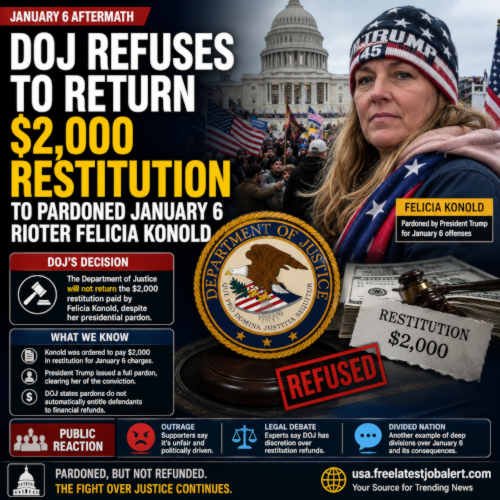

The United States Department of Justice has officially refused to return $2,000 in court-ordered restitution paid by Felicia Konold, an Arizona participant in the January 6, 2021, Capitol riot who received a full presidential pardon from President Donald Trump.
Despite the high-profile pardon, federal prosecutors are standing their ground, arguing that Konold’s underlying conviction remains legally binding.
Why the DOJ is Withholding the Restitution in 2026
According to reports from CNN, government attorneys maintain that because Konold’s conviction was final at the time she received her executive pardon and has not been formally vacated by a federal judge, the financial restitution collected as part of her sentence will not be refunded.
Konold previously pleaded guilty to obstructing law enforcement after breaching police barricades alongside members of the Proud Boys during the events at the U.S. Capitol. She ultimately served a 45-day prison sentence and was ordered to pay financial restitution.
Legal experts note that executive pardons forgive remaining prison sentences and unserved penalties, but courts have frequently treated completed financial restitutions and fines as non-refundable unless specifically ordered otherwise or if the conviction itself is legally vacated through judicial channels.
Legal and Political Aftermath of January 6 Pardons and how
The dispute highlights ongoing legal complexities surrounding the implementation of pardons for individuals prosecuted in connection with the January 6 Capitol investigations. As federal courts navigate dozens of similar post-pardon motions regarding fines, restitution, and asset forfeiture, the DOJ’s stance signals a strict adherence to procedural finality for completed monetary penalties.
The case continues to draw national attention from legal analysts, civil libertarians, and political commentators as defendants across the country test the limits of executive clemency regarding financial restitution.