
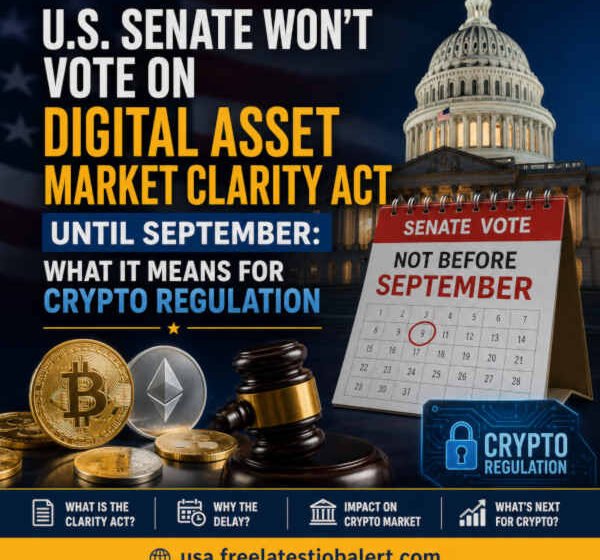

The Digital Asset Market Clarity Act will not face a floor vote in the United States Senate before lawmakers depart for their August recess. Despite intense lobbying from industry groups and late-night negotiations on Capitol Hill, Senate Majority Leader John Thune confirmed that the landmark crypto market structure legislation has been pushed to September 2026.
This procedural delay dims hopes for immediate regulatory certainty in the U.S. digital asset sector. However, key congressional leaders and major crypto trade organizations insist the legislative battle is far from over, setting up a high-stakes legislative showdown when Congress reconvenes on September 14, 2026.
Why the Clarity Act Vote Was Delayed
While the crypto sector hoped Senators would extend their session to resolve remaining sticking points, bipartisan disagreements and a congested legislative calendar ultimately derailed the pre-recess timetable.
The Senate prioritized a package of urgent end-of-session measures, including:
-
Government Funding: A continuing resolution to prevent a federal shutdown ahead of the upcoming midterm elections.
-
Foreign Policy Legislation: A major Russian sanctions bill sponsored by Senator Lindsey Graham.
-
Executive Nominations: Final confirmations for key executive and judicial appointments, including Todd Blanche for U.S. Attorney General.
Unlike these priority measures, the Clarity Act lacked a time agreement—a procedural mechanism requiring unanimous consent or structured debate limits to reach a vote efficiently. Without a time agreement, attempting to bring the bill to the floor would have triggered lengthy filibusters and protracted debate, threatening to paralyze the Senate’s remaining agenda.
Key Political Roadblocks Facing the Bill
While technical provisions regarding market oversight have largely been resolved by the Senate Banking and Agriculture Committees, political disputes remain the primary obstacle.
                     ┌─────────────────────────────────────────┐
                     │ Digital Asset Market Clarity Act Issues │
                     └────────────────────┬────────────────────┘
                                          │
         ┌────────────────────────────────┼────────────────────────────────┐
         ▼                                ▼                                ▼
┌─────────────────┐              ┌─────────────────┐              ┌─────────────────┐
│ Ethics Rules    │              │ Political &     │              │ Regulatory &    │
│ & Conflicts     │              │ Procedural      │              │ Market Issues   │
└────────┬────────┘              └────────┬────────┘              └────────┬────────┘
         │                                │                                │
 ‣ Target: Executive              ‣ 60-Vote Cloture                ‣ Stablecoin
   Crypto Holdings                  Threshold                      Yield Prohibition
 ‣ Bipartisan Concerns            ‣ Midterm Election               ‣ DeFi Infrastructure
   (Tillis-Gallego Draft)           Posturing                        Safe Harbors
1. Executive Ethics Provisions
The most contentious debate centers on ethics safeguards regarding high-ranking federal officials and their families profiting from digital asset ventures. Senate Democrats—along with Republican Senator Thom Tillis—raised strong concerns regarding disclosures involving former President Donald Trump’s reported $1 billion in crypto earnings during 2025.
Although Senator Cynthia Lummis brokered an initial compromise text, a counter-proposal introduced by Senator Tillis and Senator Ruben Gallego was sent to the White House at the end of July. The White House has yet to issue a formal response.
2. Senate Procedure and Cloture Limits
To pass the Senate, the Clarity Act requires 60 votes to invoke cloture and overcome procedural filibusters. With the Senate closely divided, supporters must secure significant bipartisan backing. Some Senate Democrats remain reluctant to hold a public vote on a major financial regulatory bill so close to the midterm elections, fearing political fallout.
3. Stablecoin Yields and DeFi Oversight
Industry negotiators continue to fine-tune specific regulatory provisions:
-
Stablecoin Yield Restrictions: Debate continues over whether non-bank digital asset platforms can offer interest or passive yield rewards on payment stablecoins.
-
DeFi Developer Exemptions: Lawmakers are refining safe-harbor language to protect non-custodial software developers while addressing law enforcement concerns regarding anti-money laundering (AML) compliance.
Breakdown: Current Legislative Landscape
| Legislative Feature | Status / Key Provision | Market Impact |
| Primary Regulator | CFTC assigned over “Digital Commodities”; SEC over “Digital Securities” | Ends jurisdictional turf wars between federal agencies. |
| DeFi Safe Harbor | Exempts pure software developers from broker-dealer status | Encourages open-source development in the U.S. |
| Stablecoin Yield | Prohibits passive interest payouts on wallet balances | Protects traditional bank deposits and credit access. |
| Senate Floor Status | Pushed to September 2026; Cloture filing expected upon return | Delays definitive regulatory certainty until autumn. |
Industry Response: Disappointment, Not Defeat
Crypto industry leaders expressed frustration over the delay but voiced optimism that a vote in September remains achievable.
“While this isn’t the result any of us hoped for when we began the week, the fight is far from over. The next few weeks we will continue to work to find the last pieces of common ground needed to set up a successful vote when Congress returns in September.”— Cody Carbone, CEO of The Digital Chamber
Ji Hun Kim, CEO of the Crypto Council for Innovation (CCI), highlighted the real-world consequences of legislative stagnation:
“There has been tremendous progress on the Clarity Act thanks to the efforts of so many… Every day without such a framework pushes American users and builders offshore and leaves consumers at risk.”
Next Steps: September Voting Timetable
When the Senate returns to Washington on Monday, September 14, 2026, lawmakers will face a tight three-week window before another scheduled recess.
-
Cloture Strategy: If Senate Majority Leader John Thune files for cloture immediately upon return on September 14, the first procedural vote on the Clarity Act could take place as early as Tuesday, September 15 or Wednesday, September 16.
-
Bipartisan Outreach: Negotiation teams will utilize the August recess to finalize compromise text on ethics provisions and banking integration.
If passed by the Senate, the reconciled bill must clear the House before heading to the President’s desk, making the September work session the most critical stretch for U.S. crypto regulation this year.