
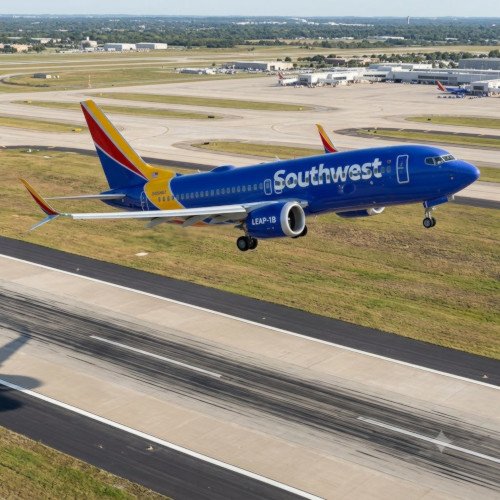

USA Commercial Aviation Breakthrough: The Federal Aviation Administration (FAA) officially issued an amended type certificate for the Boeing 737 MAX 7, the smallest and longest-range variant of Boeing’s flagship narrow-body aircraft family. The regulatory milestone clears the aircraft for production, factory deliveries, and commercial passenger service after nearly a decade of certification delays, design overhauls, and heightened regulatory oversight.
The clearance allows Boeing to begin delivering parked inventory to launch partner Southwest Airlines, while signalling a turn in Boeing’s regulatory standing following years of intense scrutiny.
Key Takeaways
-
Official FAA Clearance: The FAA granted an amended type certificate and updated Boeing’s Production Certificate No. 700 to include the 737-7 model.
-
Nearly 10 Years of Development: First flown in March 2018, the MAX 7 faced extended delays due to regulatory changes following the 2018–2019 MAX 8 crashes, manufacturing setbacks, and hardware redesign requirements.
-
Critical Technical Updates: Certification required a full redesign of the engine thermal anti-ice system, software upgrades to the flight-control computer, and enhanced pilot-alerting mechanisms mandated by the Aircraft Certification, Safety, and Accountability Act.
-
Southwest Airlines Launch Partner: Southwest holds the majority of the MAX 7 order book (over 250 orders and options) and will integrate the jet into its short-haul and high-altitude domestic networks.
-
Momentum for MAX 10: Clearing the MAX 7 validates Boeing’s updated certification pipeline, paving the way for final review of the largest variant, the 737 MAX 10.
The Road to Approval: What Delayed the MAX 7?
The 737 MAX 7’s journey to commercial readiness was marked by unprecedented regulatory scrutiny. Initially scheduled to enter passenger service in 2019, the aircraft’s approval timeline was repeatedly reset.
2018: First Test Flight ➔ 2019-2020: Global Groundings & Regulatory Overhaul ➔ 2023-2025: Engine Anti-Ice Redesign ➔ 2026: Official FAA Certification
1. Congressional Safety Mandates
Following the fatal MAX 8 accidents, U.S. lawmakers passed reformed certification laws requiring direct FAA oversight, deeper evaluations of pilot reaction times, and expanded human-factors assessments.
2. Engine Anti-Ice System Modification
A major technical obstacle emerged during testing when engineers discovered that operating the engine thermal anti-ice system in dry air for extended periods could overheat the engine cowl. Boeing developed a combined physical and software modification to prevent structural overheating, resolving the issue to the satisfaction of the FAA.
3. Cockpit Flight-Control & Alerting Systems
To meet modern airworthiness mandates, Boeing incorporated upgraded flight-control software and enhanced cockpit alerting rules, giving pilots clearer visual and acoustic cues during unexpected inflight system variations.
Boeing 737 MAX 7 Specifications vs. MAX Family
The MAX 7 is designed to replace aging Boeing 737-700 jets. It offers higher fuel efficiency, extended range, and specialized performance capabilities for high-altitude (“hot and high”) airports.
| Specification / Feature | Boeing 737 MAX 7 Profile |
| Typical Passenger Capacity | 135 to 160 seats (2-class configuration) |
| Maximum Seating | Up to 172 passengers (single class) |
| Maximum Operating Range | 3,800 nautical miles / 7,040 km (Longest in MAX family) |
| Engine Type | CFM International LEAP-1B |
| Fuel Burn & $CO_2$ Reduction | ~20% improvement compared to previous-generation 737-700 |
| Noise Footprint | 50% quieter acoustic profile |
| Key Operational Niche | High-altitude airports, long thin routes, hot-climate performance |
Operational and Economic Impact
Southwest Airlines Fleet Modernization
Southwest Airlines relies on the 737 MAX 7 to optimize capacity on routes where a 175+ seat MAX 8 or MAX 9 would be inefficient. The additional range also gives Southwest greater flexibility on longer mid-continent and over-water transcontinental sectors.
Unlocking Parked Inventory
Industry estimates indicate that Boeing has roughly 30 pre-built MAX 7 aircraft sitting in storage awaiting delivery. Receiving type certification allows Boeing to execute customer acceptances, clear balance-sheet inventory, and collect delivery payments.
Ongoing Factory Safety Monitoring
Despite issuing the type certificate, the FAA confirmed its safety inspectors will remain stationed on site at Boeing assembly facilities. Inspectors will directly monitor manufacturing execution, safety management systems (SMS), and assembly quality protocols.
Frequently Asked Questions (FAQs)
When will passengers begin flying on the 737 MAX 7?
Commercial service will begin after launch operators complete interior finalizations, pilot training checks, and fleet integration work. Deliveries will start immediately, with passenger flights scheduled over the coming months.
How does the MAX 7 compare to the rest of the 737 MAX lineup?
-
MAX 7: Smallest capacity (135–160 seats), longest range (3,800 nmi).
-
MAX 8: Core volume variant (160–180 seats), 3,500 nmi range.
-
MAX 9: Stretched fuselage (175–195 seats), 3,300 nmi range.
-
MAX 10: Largest capacity (185–210 seats), 3,100 nmi range.
What is the status of the Boeing 737 MAX 10?
The MAX 10 remains in active certification testing with the FAA. Boeing expects that lessons learned and system designs validated during the MAX 7 approval process will help expedite final certification for the MAX 10.
Industry & Regulatory Links
-
Federal Aviation Administration (FAA): Official Statement on Certification of the Boeing 737 MAX 7
-
Boeing Commercial Airplanes: Boeing 737 MAX 7 Program Specifications & Delivery Updates
-
Original Blog Post: FAA clears smallest Boeing 737 Max to fly — Aviation Blog by Jay Ratliff