
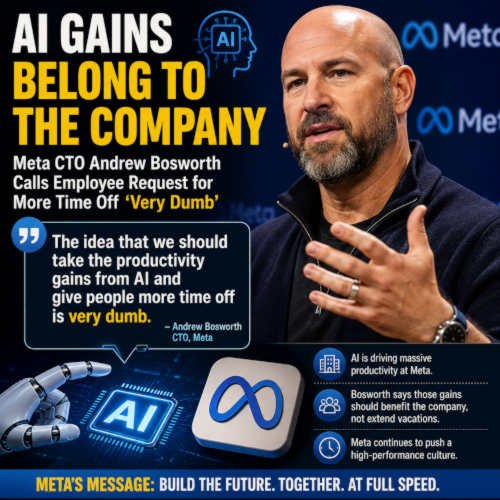

A request by a Meta employee to channel artificial intelligence-driven productivity gains into more personal time off drew a sharp and public dismissal from one of the company’s top executives. During an internal company-wide Q&A session, Chief Technology Officer Andrew Bosworth shut down a suggestion to reinstate “Meta Days”—a defunct pandemic-era program that granted employees extra paid days off—calling the inquiry “very dumb” and urging workers to direct their saved time toward producing more output.
The exchange offers a candid glimpse into how Silicon Valley leadership views the “efficiency dividend” created by generative AI tools. Rather than translating technological automation into a shorter workweek or extra leisure, executive leadership expects productivity gains to be reinvested directly into product development and corporate output.
The Exchange: “Stop Asking About Meta Days”
The tension unfolded when a Meta staffer asked Bosworth whether the efficiency gains generated by internal AI tools could be leveraged to bring back “Meta Days”. Introduced in 2020 at the height of the COVID-19 pandemic, the program was designed to mitigate employee burnout by adding four extra long weekends throughout the year. Meta eventually phased out the perk, replacing it with two discretionary “choice days” alongside its standard four-week annual paid time off policy.
Bosworth’s response to the proposal was immediate and unvarnished:
The CTO argued that extra time saved by artificial intelligence should be funnelled back into building products for the platform’s vast global user base.
Bosworth then offered a piece of corporate advice, telling the staffer: “Go to your parents and ask them, ‘Hey, like every time I get a chance to talk to my boss, [I ask him] if I can have more days off.’ Ask your parents what they think of that as a career strategy.”
Shortly after the meeting concluded, Bosworth reportedly walked back the harshness of his tone, apologising for coming down “too hard” on the questioner and acknowledging that the request may have been intended as a tongue-in-cheek comment.
The Corporate Backdrop: AI Investments vs. Restructuring
Bosworth’s blunt rejection comes at a sensitive time for Meta’s workforce. The social media giant has undergone significant operational shifts, balancing aggressive cost-cutting measures with unprecedented capital expenditure.
┌────────────────────────────────────────────────────────────────────────┐
│                        META'S OPERATIONAL SHIFT                        │
├───────────────────────────────┬────────────────────────────────────────┤
│ Metric / Initiative           │ Details & Context                      │
├───────────────────────────────┼────────────────────────────────────────┤
│ Capital Commitment            │ $135 Billion dedicated to AI sub-      │
│                               │ structure and development              │
│ Headcount Reductions          │ ~8,000 workforce cuts implemented      │
│ Standard Leave Policy         │ 4 weeks PTO + 2 discretionary "choice" │
│                               │ days (replacing Meta Days)             │
│ Performance Metric Trend      │ Heavy emphasis on internal AI tool     │
│                               │ adoption & output benchmarks           │
└───────────────────────────────┴────────────────────────────────────────┘
The contrast between corporate restructuring and massive capital outlays highlights the pressure felt across tech teams. In May, Meta eliminated approximately 8,000 roles in a strategic pivot aimed at streamlining operations. Concurrently, the firm committed upwards of $135 billion toward artificial intelligence development, infrastructure, and compute capacity.
This dynamic is not unique to Meta, but the executive leadership’s messaging reflects an underlying expectation: employees who retain their roles in the age of AI are expected to leverage automation tools to increase their net contributions rather than reduce their active working hours.
A Familiar Reaction from Meta Leadership
Bosworth’s response echoes similar sentiments expressed by Meta Chief Executive Officer Mark Zuckerberg in 2022 when the “Year of Efficiency” strategy was first taking shape.
During a town hall meeting that year, when asked if “Meta Days” would continue amidst an economic slowdown, Zuckerberg expressed visible irritation:
The repeated pushback from top leadership underscores a clear organisational boundary regarding employee perks. While Meta continues to offer robust compensation and traditional paid leave benefits, management has firmly rejected the notion that crisis-era wellness programs will return as permanent fixtures.
The AI Workplace Divide
The debate over what to do with AI-generated time savings touches on a fundamental question currently confronting the global labor market: Who owns the productivity gains of artificial intelligence?
Prominent voices across technology and finance hold vastly divergent views on how AI will reshape the standard workweek:
-
The Output-Maximized Model (Employer Perspective): As articulated by Bosworth and adopted by many corporate leaders, AI is seen as a tool to scale output. If an engineer saves 10 hours a week using coding assistants, those 10 hours are expected to be spent writing additional software or developing new features.
-
The Post-Work / Reduced-Labor Model: Industry figures like Microsoft co-founder Bill Gates and Amazon founder Jeff Bezos have envisioned broader societal shifts where AI-driven efficiency could eventually reduce mandatory labor hours, potentially supporting shorter workweeks or allowing households to operate comfortably with fewer working hours.
-
The Fractional Work Model: Financial institutions, including Morgan Stanley, have suggested that AI-driven efficiency might allow individuals to easily manage multiple part-time positions or side projects simultaneously, shifting the structure of traditional full-time employment.
For corporate leaders like Bosworth, the math remains straightforward: efficiency gains belong to the enterprise. With high-level executive compensation tightly bound to aggressive company performance targets and market valuations—Bosworth himself holds stock options tied to Meta reaching ambitious long-term valuation metrics—the mandate from the top remains centred on continuous acceleration rather than extra time off. Have a nice day