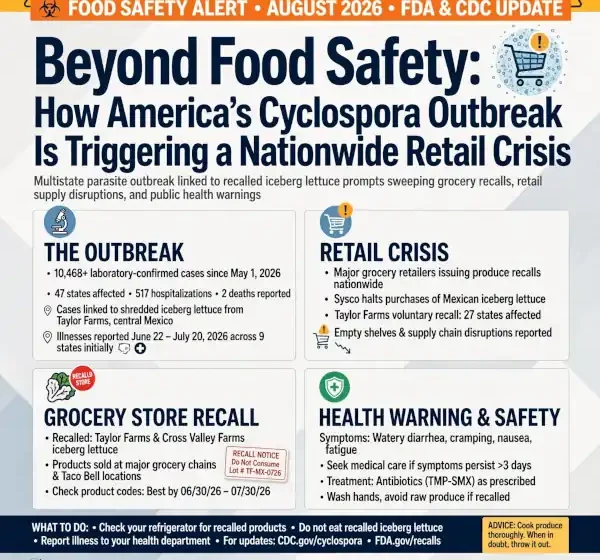

WASHINGTON — What began as a targeted food safety recall has rapidly expanded into a major consumer confidence crisis across the American grocery, restaurant, and food distribution sectors. A widespread outbreak of Cyclospora cayetanensis—a waterborne parasite linked to imported iceberg lettuce sourced from central Mexico—has now spread across 15 states, leaving tens of thousands sick and dealing a severe economic blow to the fresh produce industry.
With national cases surpassing 25,000—more than five times the previous U.S. record set in 2019—consumer anxiety is reshaping shopping habits and threatening revenues for food businesses nationwide.
Outbreak Impact at a Glance
| Metric / Indicator | Reported Data | Significance / Industry Context |
| Total National Cases | Exceeds 25,000 cases | Highest recorded total in modern U.S. history |
| Hardest-Hit State | Michigan (12,000+ cases, 2 deaths) | Represents nearly half of all national reported illnesses |
| States Affected | 15 U.S. states | Regional distribution spread across Midwest and East Coast |
| Fresh Lettuce Sales | Down 9% week-over-week | NielsenIQ unit sales data ending mid-July |
| Prepackaged Salads | Down 14% | Sharp decline in packaged produce purchases |
| Taco Bell Foot Traffic | Plunged 20.8% | Impact following public association with recalled ingredients |
From Farm Recall to Retail Disruption
The outbreak was traced to iceberg lettuce processed by Taylor Farms de Mexico and distributed across major retail chains and fast-food franchises. Although targeted recalls were initiated, public fear quickly spilled over into the broader produce section.
Consumer behavior has shifted dramatically as shoppers struggle to differentiate between safe and implicated supply chains:
-
Widespread Sales Declines: NielsenIQ data reveals that fresh lettuce unit sales dropped 9% nationwide, while prepackaged salad sales tumbled 14% as cautious shoppers avoided the leafy greens aisle altogether.
-
Restaurant Traffic Drops: Taco Bell experienced a 20.8% plunge in foot traffic after public health notices linked certain locations to the recalled lettuce.
-
Collateral Damage to Unrelated Brands: Fast-casual salad chain Sweetgreen—which does not use iceberg lettuce from the implicated region—was forced to cut its full-year comparable-sales forecast to a 7% to 8% decline as general consumer apprehension suppressed overall salad demand.
“The core issue facing retailers isn’t just managing the recalled inventory—it’s a fundamental lack of consumer differentiation. When shoppers can’t easily verify where their greens were grown, they stop buying greens altogether.” — Retail Industry Analysis
Supply Chain Realignment: Shifting to Local and Domestic Sourcing
To restore public trust, major food distributors and retailers are making rapid supply chain adjustments. Sysco, America’s largest food distributor, announced a complete pivot away from Mexican iceberg lettuce, shifting its sourcing exclusively to domestic U.S. growers.
At the same time, health-conscious consumers are seeking alternatives with greater supply chain transparency. Regional farmers markets and local farm stands have reported sales increases of 15% to 30% as shoppers prioritize locally grown, easily traceable produce.
Health Awareness: Understanding Cyclospora and Protecting Your Family
Cyclospora cayetanensis is a microscopic parasite that contaminates food or water, typically when produce is irrigated or washed with contaminated water supplies. Unlike bacterial contamination, Cyclospora cannot be easily washed off produce with plain water.
Common Symptoms
Symptoms generally appear within one to two weeks after consuming contaminated food and can last from several days to a month or longer if untreated:
-
Severe, watery diarrhea and digestive cramping
-
Bloating, gas, and nausea
-
Low-grade fever, fatigue, and significant weight loss
Action Steps for Consumers
-
Check Recall Notices: Verify that bagged salads or whole lettuce heads in your refrigerator do not originate from recalled central Mexico processing facilities.
-
Proper Disposal: Throw away any recalled produce immediately; do not attempt to cook or wash contaminated greens.
-
Seek Targeted Medical Care: If experiencing prolonged gastrointestinal symptoms, consult a healthcare provider. Standard stool tests often miss Cyclospora, requiring a specific PCR or parasitic lab order.
As federal agencies and retailers work to restore supply chain integrity, consumer education and clear sourcing labels remain the most effective tools to rebuild trust in America’s fresh food ecosystem.