
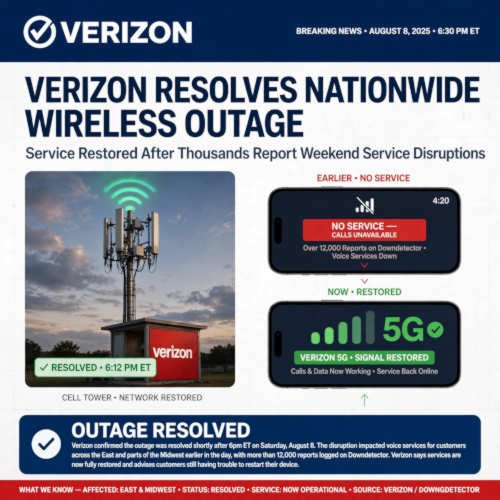

WASHINGTON : Verizon has fully restored service to thousands of wireless customers across the United States following a significant service disruption on Saturday, August 8, that left users unable to make or receive mobile phone calls.
The disruption, which primarily targeted voice services across the East Coast and parts of the Midwest, triggered a flood of complaints on outage-tracking platforms and social media before network engineers contained and resolved the issue later that evening.
The Outage by the Numbers
According to data compiled by Downdetector—a platform that tracks service disruptions based on real-time user reports—complaints began surging in the late afternoon on Saturday.
| Metric / Aspect | Data & Key Findings |
| Peak Reports | 12,319+ user complaints recorded around 5:25 p.m. ET |
| Primary Issue | 91% reported problems making or receiving mobile calls |
| Secondary Issues | 5% mobile internet disruptions; 3% 5G Home Internet issues |
| Primary Regions | East Coast (Boston, New York, Washington D.C.) and Midwest (Chicago) |
| Resolution Time | Systems fully recovered within approximately 3–4 hours |
While mobile internet and text messaging services remained functional for most subscribers, the inability to place standard cellular phone calls led to widespread frustration. Some customers reported that their mobile devices temporarily dropped into emergency or “SOS” satellite modes during the height of the disruption.
Geographic Reach and User Impact
Reports of service failures spanned multiple major metropolitan hubs. Customers in cities including New York, Boston, Washington D.C., Chicago, and Los Angeles flooded online forums to confirm local network outages.
The impact was not limited to direct Verizon Wireless subscribers. Customers using Mobile Virtual Network Operators (MVNOs) that rely on Verizon’s cellular infrastructure—such as Visible—also reported failed calls and connection drops during the afternoon window.
“We are aware of an issue impacting voice services for wireless customers in some parts of the U.S.,” Verizon said in a statement issued during the height of the outage. “Our engineers are engaged and we are working quickly to identify and resolve the issue. We know how much people rely on Verizon and apologize for any inconvenience.”
Technical Resolution and Customer Next Steps
By Saturday evening, Verizon confirmed that network engineers had successfully mitigated the underlying voice service glitch. Outage reports on Downdetector rapidly declined back to baseline levels, and normal calling capabilities were restored nationwide.
“Our engineers have resolved the issue that affected voice services for some wireless customers this afternoon. We know how much you rely on us, and we’re sorry for the inconvenience. If you are still having any trouble with your service, please try restarting your device.” — Verizon Corporate Communications
For users who continue to experience lingering connectivity issues following a network restoration, telecommunication experts recommend the following troubleshooting steps:
-
Perform a Soft Reset: Power off the smartphone completely, wait 30 seconds, and turn it back on to force the device to re-register with the nearest cell tower.
-
Toggle Airplane Mode: Switch Airplane Mode “ON” for 10 seconds and then “OFF” to refresh the cellular modem connection.
-
Reset Network Settings: On iOS or Android devices, navigate to Network Settings and select “Reset Network Settings” to clear outdated tower handoff caches.
-
Check Network Status: Visit Verizon’s official Check Network Status page to verify localized cell tower maintenance in specific ZIP codes.
While brief network hiccups occur periodically across major telecommunication providers, Saturday’s outage underscores the critical dependence of residential and business customers on reliable mobile voice infrastructure. Verizon has not yet disclosed the specific root cause behind the voice network failure but indicated that internal post-mortem reviews are standard protocol following any multi-region service event.