
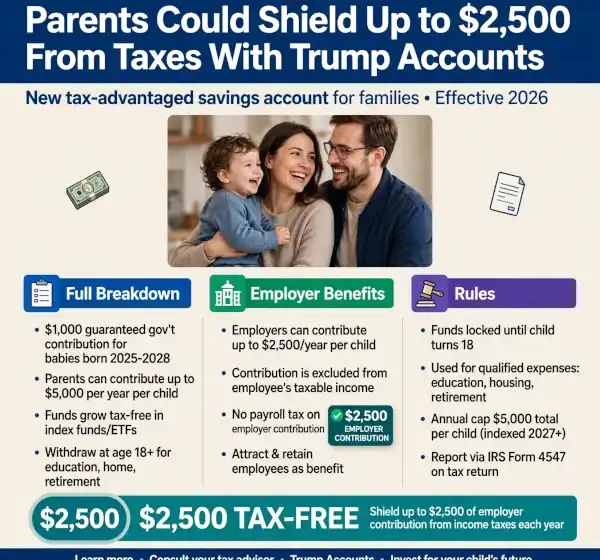

WASHINGTON: Under newly implemented federal tax legislation, American families have access to a novel tax-advantaged vehicle for their children: Trump Accounts (officially designated under Section 530A of the Internal Revenue Code). Created as part of the One Big Beautiful Bill Act, these specialised child investment accounts allow parents, legal guardians, and extended family members to build long-term wealth for minors starting at birth.
Among the most lucrative features of the law is a corporate benefit provision that allows working parents to shield up to $2,500 per child from taxable income each year through qualifying employer contribution programs.
What Is a Trump Account (Section 530A IRA)?
A Trump Account is a tax-deferred investment account designed specifically for children under the age of 18 who possess a valid Social Security number. Unlike traditional 529 plans or custodial accounts, a Trump Account functions as a long-term retirement vehicle that accumulates compound growth throughout childhood and automatically converts into a traditional Individual Retirement Account (IRA) when the child turns 18.
                 TRUMP ACCOUNT LIFECYCLE (SECTION 530A)

   [ BIRTH TO AGE 17 ]                    [ AGE 18 & BEYOND ]
   -------------------                    -------------------
 * Annual Limit: $5,000                   * Converts to Traditional IRA
 * Employer Max: $2,500 (Tax-Free)       * Standard IRA Rules Apply
 * Federal Deposit: $1,000 (2025-2028)    * Investments Unlocked
 * Low-Cost Index Funds/ETFs Only         * Penalty-Free Distributions
 * Zero Early Withdrawals                   at Age 59½ (Exceptions Apply)
During the child’s minority (known as the growth period), funds cannot be withdrawn for education, healthcare, or everyday expenses. Instead, assets remain locked to maximise decades of uninterrupted, tax-deferred compounding.
How Parents Can Shield Up to $2,500 From Taxes
While individual contributions from parents or grandparents are made with after-tax dollars, employer contributions receive unique tax-exempt status.
If an employer establishes a qualifying Trump Account Contribution Program, the business can contribute up to $2,500 annually per employee’s dependent child.
-
Tax Exclusion for Employees: Employer contributions up to $2,500 per child are excluded from the worker’s gross income. This reduces both federal income tax and payroll tax (FICA) liabilities for working parents.
-
Deduction for Employers: Participating employers can deduct these contributions as standard compensation expenses.
-
Tax-Deferred Growth: The contributed capital grows tax-free within the child’s Section 530A IRA until distributions begin decades later.
For a middle-class household with two dependent children whose employers offer full matching contributions, the family can effectively shelter $5,000 per year in total compensation from tax exposure while jumpstarting their children’s financial security.
Key Contribution Limits & The $1,000 Newborn Seed Grant
Understanding how different funding sources interact is vital to staying within annual federal limits:
| Funding Source | Annual Max per Child | Tax Treatment for Parents | Notes & Special Rules |
| Parents & Relatives | Up to $5,000 | After-tax dollars (Non-deductible) | Anyone can contribute up to the joint cap. |
| Employer Programs | Up to $2,500 | Excluded from Taxable Income | Counts toward the total $5,000 annual limit. |
| Federal Seed Grant | $1,000 (One-time) | 100% Tax-Free Government Deposit | Applies only to babies born 2025–2028. |
| Philanthropic Grants | Varies | Tax-Exempt | Non-profits can contribute to geographic cohorts. |
The $1,000 Federal Grant for Newborns
Children born between January 1, 2025, and December 31, 2028, are eligible to receive a one-time $1,000 federal deposit directly from the U.S. Treasury into their Trump Account. Crucially, this $1,000 seed payment does not count toward the $5,000 annual contribution cap.
Investment Rules: Low-Cost Indexing Protection
To prevent financial firms from draining childhood accounts with high fees, statutory guardrails govern how Trump Account assets are invested during the growth period:
-
Mandatory Indexing: Portfolio managers must invest exclusively in low-cost U.S. equity index funds or broad-market ETFs. Individual stock picking, speculative options trading, and active management strategies are prohibited.
-
Strict Expense Ratio Cap: Total management fees and administrative costs are capped by federal law at 0.10% (10 basis points) annually, preserving net returns for account holders.
How to Open a Trump Account for Your Child
Opening a Trump Account involves specific IRS filing requirements to claim federal seed money and connect employer benefit channels.
-
Obtain a Valid SSN: Ensure your child has an official Social Security Number registered with the Social Security Administration.
-
File IRS Form 4547: Submit IRS Form 4547 (Election for Trump Child Savings Account) through your online IRS.gov account, tax preparation software, or the official platform at
TrumpAccounts.gov. -
Elect the $1,000 Grant: If your child was born between 2025 and 2028, check the election box on Form 4547 to request the $1,000 Treasury contribution.
-
Select an Approved Custodian: Choose an accredited financial institution or brokerage to manage the Section 530A IRA.
-
Set Up Employer Payroll Deductions: If your employer offers a Trump Account Contribution Program, submit your account details to HR to initiate tax-sheltered employer contributions up to $2,500.
Trump Accounts vs. 529 Plans vs. Custodial Roth IRAs
When designing a family wealth strategy, parents must weigh Section 530A accounts against traditional college savings vehicles.
                     SAVINGS VEHICLE COMPARISON

   [ TRUMP ACCOUNT (530A) ]      [ 529 COLLEGE PLAN ]       [ CUSTODIAL ROTH IRA ]
   ------------------------      --------------------       ----------------------
   * Target: Retirement          * Target: Education        * Target: Retirement/Wealth
   * Earned Income: No           * Earned Income: No        * Earned Income: Required
   * Employer Match: $2.5k Tax-Free * Employer Match: Rare   * Employer Match: No
   * Lockup: Until Age 18        * Lockup: Penalty on Non-Edu * Lockup: Flexible Basis Rules
-
529 College Savings Plans: Best for college, trade school, and K-12 private tuition. Qualified withdrawals are 100% tax-free, whereas Trump Account withdrawals in adulthood are taxed as ordinary income.
-
Custodial Roth IRAs: Require the minor to have legitimate earned income (e.g., modeling, lawn care, W-2 jobs). Trump Accounts require zero earned income, allowing parents to invest for newborns on day one.
FAQS
Can parents deduct their own contributions to a Trump Account on their tax returns?
No. Individual contributions made by parents, grandparents, or legal guardians are made with after-tax dollars and are non-deductible. Only employer contributions up to $2,500 are excluded from taxable employee wages.
Does a child need earned income to have a Trump Account?
No. Unlike a Roth IRA, children do not need earned income to qualify for a Trump Account. Any minor under age 18 with a valid Social Security number is eligible.
What happens to a Trump Account when the child turns 18?
On the child’s 18th birthday, the growth period ends, and the account automatically converts into a traditional Individual Retirement Account (IRA) held directly in the young adult’s name. Standard IRA withdrawal and penalty rules apply thereafter.
What happens if total contributions exceed the $5,000 annual limit?
Any amount contributed beyond the $5,000 annual limit across all sources (family + employer) is considered an excess contribution. Excess funds must be withdrawn prior to filing tax returns to avoid excise tax penalties.
Can funds in a Trump Account be used for college or early home purchases?
During the growth period (under age 18), zero distributions are permitted for any reason. After age 18, standard traditional IRA exceptions (such as first-time home purchases or qualified higher education expenses) apply, though earnings remain subject to ordinary income taxes.