
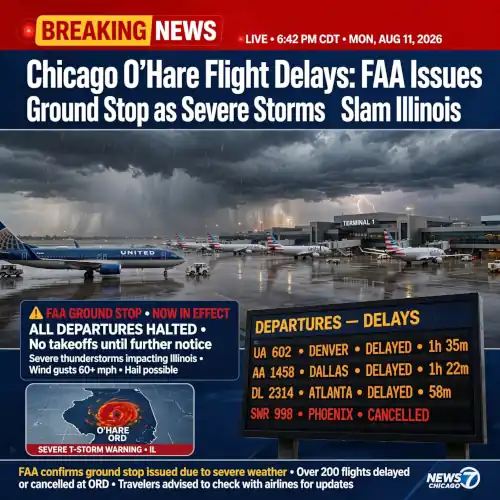

Chicago Business updates: The Federal Aviation Administration (FAA) issued a ground stop for inbound flights heading to Chicago O’Hare International Airport (ORD). The measure was enacted as a dangerous, fast-moving line of severe thunderstorms swept across Illinois, threatening air safety with destructive wind gusts, heavy downpours, and potential tornadoes.
The FAA initially mandated that Chicago-bound departures from specific originating U.S. airports remain grounded through 10:00 a.m. CT, with aviation officials warning that restrictions could be extended as convective weather patterns developed across northern Illinois.
Severe Weather Threat and Aviation Impact
The severe weather outbreak developed from an intense squall line moving eastward from Iowa into the Chicago metropolitan area. The National Weather Service (NWS) and meteorologists placed the primary window of severe weather between 9:00 a.m. and 3:00 p.m. CT, issuing a widespread Severe Thunderstorm Watch for Cook County and surrounding regions.
| Operational Metric | Status / Impact |
| Primary Affected Hub | Chicago O’Hare International Airport (ORD) |
| Secondary Affected Hub | Chicago Midway International Airport (MDW) |
| Primary Regulatory Action | FAA Ground Stop (Inbound Chicago Departures Held) |
| Secondary Regulatory Action | Ground Delay Program (Active through 10:00 p.m. CT) |
| Associated Hazards | Destructive winds, severe turbulence, hail, and brief tornadoes |
Ground Stop vs. Ground Delay Program: What Travelers Need to Know
When convective weather impacts major hub airports, the FAA Air Traffic Control System Command Center utilizes two primary traffic management initiatives to prevent dangerous airspace congestion:
┌─────────────────────────────────────────────────────────────┐
│              FAA TRAFFIC MANAGEMENT INITIATIVES             │
└─────────────────────────────────────────────────────────────┘
                               │
         ┌─────────────────────┴─────────────────────┐
         ▼                                           ▼
[GROUND STOP]                               [GROUND DELAY PROGRAM]
• Stricter, immediate freeze                • Metered arrival flow
• Inbound aircraft held on ground           • Average delays assigned to departures
• Enacted during active severe cells        • Extends well past storm passage
-
Ground Stop: A strict operational freeze requiring aircraft scheduled to fly to Chicago to remain on the tarmac at their departure airports. This prevents planes from entering holding patterns near active thunderstorm cells or burning excess fuel while waiting to land.
-
Ground Delay Program (GDP): In addition to the ground stop, the FAA implemented a Ground Delay Program running until 10:00 p.m. CT. Under a GDP, incoming flights are assigned specific departure slots to stagger arrivals over several hours, helping air traffic control manage reduced runway acceptance rates caused by cloud cover, rain, and lightning.
Disruptions at Chicago Midway and Regional Airspace
Chicago’s second major hub, Chicago Midway International Airport (MDW), was also severely impacted by the storm front. With heavy thunderstorm cells tracking across Cook County, Midway experienced notable flight delays and arrival disruptions.
Because O’Hare and Midway serve as major hub facilities for major U.S. carriers—including United Airlines and American Airlines—ground stoppages in Chicago trigger significant ripple effects nationwide. Aircraft held on the ground in Chicago miss downstream flight legs, while flight crews face potential federal duty-hour limit timeouts, driving secondary cancellations across domestic flight networks.
Guidelines for Impacted Passengers
If you are flying to, from, or connecting through Chicago O’Hare or Midway during this storm event, travel experts and airlines recommend taking immediate steps:
-
Monitor Live Flight Status: Check your airline’s mobile app or website frequently before leaving for the airport. Flight statuses change rapidly during active FAA ground delay programs.
-
Utilize Airline Travel Waivers: Major carriers operating out of ORD typically issue weather waivers during severe convective events. These waivers allow passengers to change their travel dates or origin/destination hubs without paying change fees or fare differences.
-
Avoid Short Connections: If connecting through O’Hare, check if your second leg is delayed. If your connection buffer drops below 45–60 minutes, use self-service rebooking tools in your airline app to secure a later connecting flight.
-
Prepare for Tarmac Delays: Arriving flights may experience gate holds after landing if ramp closures are triggered by lightning strikes near the airport perimeter.