
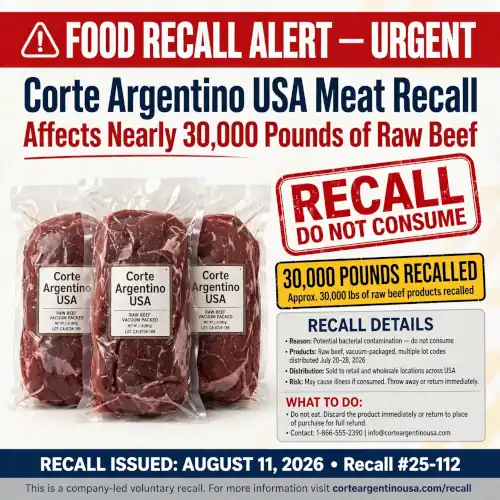

USA News business: Federal food safety officials have issued a high-priority Class I recall covering nearly 30,000 pounds of imported raw beef after uncovering that the shipment entered the United States commercial supply chain without undergoing mandatory federal reinspection.
The recall, initiated by Aventura, Florida-based importer Corte Argentino USA LLC, involves 29,628 pounds of raw, boneless beef cuts sourced from Argentina. According to an official announcement by the U.S. Department of Agriculture’s Food Safety and Inspection Service (FSIS), the affected meat was distributed to commercial distributors and retail locations across Florida and Texas.
The issue was uncovered during routine FSIS surveillance activities. Because imported meat that bypasses reinspection cannot be verified for sanitation, safety, or compliance with U.S. standards, the agency classified the incident as a Class I Health Hazard—the highest level of recall risk, indicating a reasonable probability that consumption of the product could lead to serious, adverse health consequences or death.
Breakdown of the Recalled Argentine Beef Products
The recalled items consist of various wholesale cardboard shipping boxes containing specific primal and subprimal cuts produced by Argentine beef processor Frigorífico Gorina SAIC. The products were packaged and processed between May 15, 2026, and May 20, 2026, bearing use-or-freeze-by dates spanning from September 15, 2026, through September 20, 2026.
Every affected package bears the Argentinian official establishment mark “EST. N° OF. 2025” alongside the specific shipping mark “26644-AA”.
| Product Cut Name (English) | Spanish Trade Name | Package Identification Marks | Production & Use-By Window |
| Top Sirloin Butt | Cuadril Sin Tapa | EST. N° OF. 2025 / Mark 26644-AA |
Produced: May 15–20, 2026
Use/Freeze-By: Sept 15–20, 2026
|
| Eye Round | Peceto | EST. N° OF. 2025 / Mark 26644-AA |
Produced: May 15–20, 2026
Use/Freeze-By: Sept 15–20, 2026
|
| Topside Cap Off | Nalga AD S/Tapa | EST. N° OF. 2025 / Mark 26644-AA |
Produced: May 15–20, 2026
Use/Freeze-By: Sept 15–20, 2026
|
| Flat | Carnaza Cuadrada | EST. N° OF. 2025 / Mark 26644-AA |
Produced: May 15–20, 2026
Use/Freeze-By: Sept 15–20, 2026
|
| Knuckle | Bola de Lomo | EST. N° OF. 2025 / Mark 26644-AA |
Produced: May 15–20, 2026
Use/Freeze-By: Sept 15–20, 2026
|
Why Import Reinspection Matters for US Food Safety
Under federal law, all foreign meat, poultry, and egg products imported into the United States must clear a multi-layered regulatory gateway before entering public commerce:
-
Equivalence & Country Clearance: The country of origin must maintain a meat inspection system equivalent to that of the United States.
-
Customs & Border Protection (CBP): Border agents review customs documentation and biosecurity protocols.
-
FSIS Import Reinspection (The Bypassed Step): Shipments must physically present at an official FSIS import inspection facility. Here, inspectors verify paperwork, inspect container seals, examine physical labeling, check product temperature, evaluate packaging integrity, and perform microbiological or chemical residue sampling.
When a shipment bypasses the mandatory FSIS import reinspection facility, the agency cannot confirm whether the meat was kept at safe holding temperatures, exposed to environmental contaminants, or processed under hygienic conditions. As a result, uninspected shipments are automatically deemed adulterated and unsafe for public consumption.
Health Risk Profile and Illness Reports
As of the official recall announcement, there have been no confirmed reports of illness, injury, or adverse reactions linked to the consumption of these recalled beef products.
However, because uninspected raw meat can potentially harbor foodborne pathogens—including Escherichia coli (E. coli), Salmonella, or Listeria monocytogenes—health officials urge extreme caution. Symptoms of foodborne illness typically include:
-
Severe abdominal cramping and stomach pain
-
Watery or bloody diarrhea
-
Nausea and persistent vomiting
-
Low-grade fever and fatigue
Anyone who suspects they may have consumed the recalled meat and experiences severe gastrointestinal symptoms should seek medical attention immediately.
Guidance
Because these boneless beef cuts carry extended use-or-freeze-by dates extending through late September 2026, regulatory authorities are deeply concerned that the product may be sitting in household or commercial freezers and refrigerators.
┌─────────────────────────────────────────────────────────┐
│                 ACTION PLAN FOR CONSUMERS               │
└─────────────────────────────────────────────────────────┘
                            │
       ┌────────────────────┴────────────────────┐
       ▼                                         ▼
[CHECK YOUR FREEZER]                     [DO NOT CONSUME]
Verify box/label marks:                  Throw affected meat away
• EST. N° OF. 2025                       or return to place of
• Shipping Mark: 26644-AA                purchase for a full refund.
Key Steps to Follow:
-
Identify the Packaging: Check any raw Argentine beef purchased in Florida or Texas for establishment number “EST. N° OF. 2025” and shipping mark “26644-AA”.
-
Do Not Prepare or Serve: Do not cook, serve, or sell any meat matching these descriptions, even if it appears fresh and smells normal.
-
Dispose or Return: Throw the product away securely in a sealed bag so pets or wildlife cannot access it, or return it to the retail seller for a refund.
-
Sanitize Storage Areas: If the raw meat was stored in a domestic refrigerator or commercial cooler, thoroughly sanitize all surrounding shelves, drawers, and surfaces with hot, soapy water or an approved antibacterial solution.
FSIS is actively conducting recall effectiveness checks to verify that Corte Argentino USA LLC and its wholesale distributors have removed all affected product from market channels and notified retail partners.