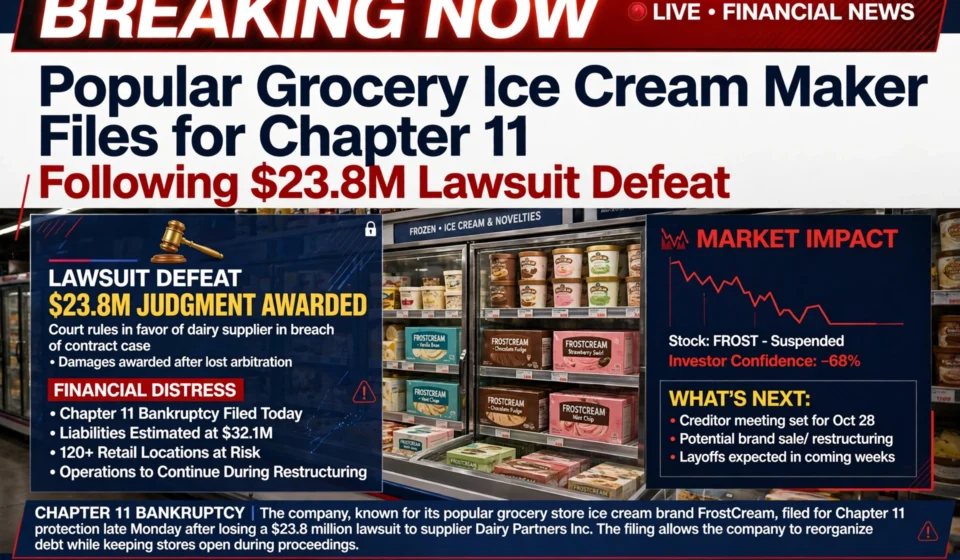
Popular Grocery Ice Cream Maker Files for Chapter 11 Following $23.8M Lawsuit Defeat. Breaking Now

SALT LAKE CITY & NEW YORK: Rebel Creamery LLC, the Utah-based pioneer of keto-friendly, low-carb ice cream sold across thousands of Walmart, Target, Kroger, and Safeway stores nationwide, has officially filed for Chapter 11 bankruptcy protection in the U.S. Bankruptcy Court for the District of Utah.
The emergency restructuring filing comes directly on the heels of a July 16 federal court judgment ordering Rebel to pay rival artisan dessert brand Van Leeuwen Ice Cream a staggering $23.785 million for intentional trade dress infringement and dilution.
With $13.78 million in total assets stacked against $23.85 million in liabilities—virtually all tied to the adverse court award Rebel turned to Chapter 11 to trigger an immediate automatic stay while it redesigns its product line and appeals the multi-million-dollar verdict.
Before you read the full story, know what the Chapter 11 USA legal process is also. It is nothing but a bankruptcy code where a business owner can reorganise and pay debts during the business operation mode.
Anatomy of the Freezer Aisle Clash
The conflict dates back to 2021, when Brooklyn-founded Van Leeuwen Ice Cream filed a federal intellectual property lawsuit in the Eastern District of New York. Van Leeuwen, which began as a street truck concept in 2008 before scaling into a national grocery fixture, accused Rebel of copying its iconic, minimalist packaging.
In intellectual property law, “trade dress” protects the distinctive visual appearance and overall commercial impression of a product when consumers associate that aesthetic directly with a brand.
Van Leeuwen established that its protected trade dress features:
- Uniform, monochromatic cardboard pints paired with colour-matching lids.
- Distinctive, muted pastel palettes across flavour variations.
- A clean, uncluttered layout absent of loud food photography.
- Custom black script typography highlighted by an exaggerated capital initial.
When Rebel Creamery rolled out its nationwide expansion, its containers adopted a strikingly similar pastel, text-focused design. Van Leeuwen’s legal team argued that the visual crossover led to widespread consumer confusion in retail grocery freezers, where busy shoppers frequently mistook Rebel’s keto products for Van Leeuwen offerings.
Willful Copying and Profit Disgorgement
Following a multi-year legal battle and trial, U.S. District Judge Eric Komitee delivered a sweeping ruling against Rebel Creamery.
Court records revealed that while Van Leeuwen hired global design agency Pentagram in 2016 to engineer its grocery look, Rebel founders Austin and Courtney Archibald developed their packaging using Adobe Illustrator without formal graphic design experience, keeping only a final digital file with no recorded earlier iterations.
Van Leeuwen initially demanded $36.4 million in gross profit disgorgement. However, Judge Komitee slashed the damages award by 33%, factoring in financial data showing that a significant portion of Rebel’s sales was driven by organic consumer demand for ketogenic, high-fat, zero-sugar recipes rather than the packaging aesthetic alone.
The adjusted figure remained a crippling $23.785 million.
Why Chapter 11 Was the Only Move
For a mid-sized consumer packaged goods (CPG) brand with $5.22 million in cash on hand, absorbing a single $23.785 million liability was an existential threat.
Rebel filed an appeal with the U.S. Court of Appeals for the Second Circuit. Under federal procedure, staying the enforcement of a monetary judgment during an appeal normally requires posting a supersedeas bond matching or exceeding the full judgment value. Lacking the collateral to secure such a bond, Chapter 11 provided an immediate legal shield through the Section 362 automatic stay, halting collection actions while the company reorganizes.What This Means for Grocery Shelves and the CPG Industry
The case represents one of the largest trade dress awards ever levied against a packaged food startup, sending a loud warning to emerging brands and venture investors across retail aisles.
- Shelves Won’t Go Empty Immediately: Operating as a Debtor-in-Possession, Rebel Creamery will maintain daily fulfilment, paying vendors and supplying retail partners like Walmart, Kroger, Safeway, and Target while executing a complete packaging overhaul.
- Packaging Is Protected Property: The multi-million-dollar judgment proves that minimalist colour palettes, font placement, and overall shelf presence carry strict intellectual property weight—even in the absence of traditional word-mark infringement.
- The Long-Term Outcome: Rebel’s future now rests on its Second Circuit appeal and its ability to negotiate a sustainable plan of reorganisation to resolve Van Leeuwen’s claim while rolling out its newly compliant branding.