
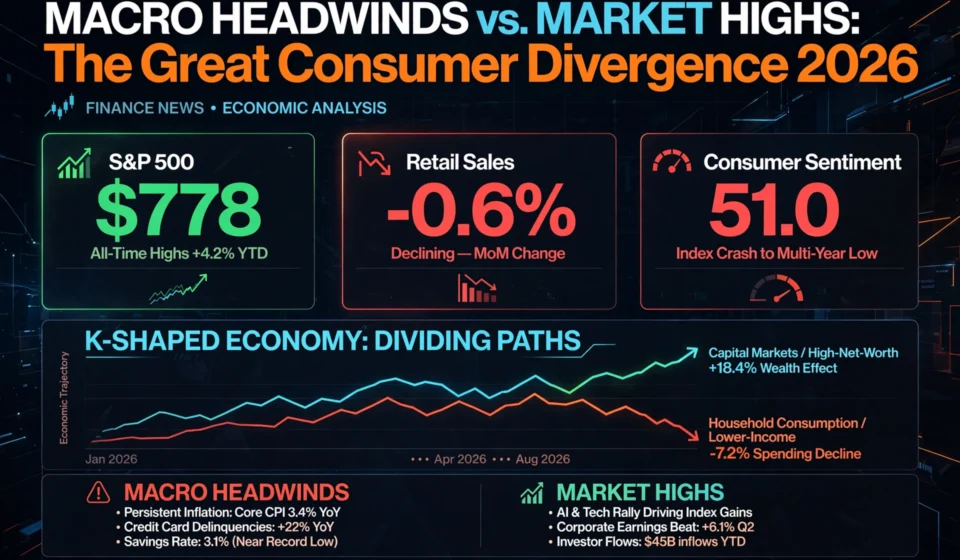

NEW YORK — Wall Street opened the third week of August 2026 balancing on a high-wire act of historic proportions. On one side stands a relentless equity bull market, with the S&P 500 hovering near all-time records and equity volatility tumbling to yearly lows. On the other sits an increasingly strained American household, battered by persistent cost-of-living pressures, cratering sentiment, and the sharpest contraction in retail activity recorded in over twelve months.
As market participants digest a sudden barrage of downbeat macroeconomic prints, the stage is set for a pivotal week. An impending gauntlet of second-quarter big-box retail earnings—featuring quarterly scorecards from Home Depot, Target, Lowe’s, and Walmart—alongside the release of contentious Federal Open Market Committee (FOMC) meeting minutes will test whether prevailing market complacency can withstand emerging cracks in consumer fundamentals.
The Macroeconomic Shock: Spending Stalls, Sentiment Plunges
The catalyst behind the market’s current soul-searching arrived late last week with the release of the July retail sales report. Commerce Department data revealed a 0.6% month-over-month drop in overall retail purchases, starkly missing consensus projections of a modest 0.1% gain. The contraction marked the steepest monthly decline in retail volume in more than a year.
A granular look into the underlying categories dispelled early hopes that the drop was merely a byproduct of fluctuating energy prices:
- Automotive: Auto dealerships and parts suppliers posted a 1.8% decline, reflecting elevated financing costs and buyer hesitation.
- Gas Stations: Service station receipts dropped 0.9%, trailing broader energy adjustments.
- Nonstore Retailers: Online sales tumbled 2.2%, heavily influenced by calendar shifts in mid-summer promotional events like Amazon Prime Day.
- Core Sales (Control Group): Even when stripping out the volatile gas and automotive categories, underlying retail sales fell 0.2%, signaling a systemic deceleration in discretionary outlays.
Compounding the weak spending figures, the preliminary August survey from the University of Michigan arrived with an unexpected thud. The benchmark Consumer Sentiment Index sank to 51.0, falling sharply from July’s reading of 55.2 and trailing Wall Street estimates near 55.0.
The report captured an 8% monthly deterioration in public mood, snapping a two-month stabilization trend. Expectations for short-term business conditions tumbled 11%, while long-term economic outlooks dropped 17%. Strikingly, only 8% of respondents reported expectations that their household income would outpace inflation over the coming twelve months.
Adding a stagflationary tint to the consumer picture, short-term 1-year inflation expectations ticked upward to 4.3% from 4.2%. This divergence—where consumer inflation expectations edge higher even as headline consumer and producer price indices moderate—highlights the psychological persistence of cumulative price gains on household budgets.
The Wall Street Disconnect: Record Valuations Meet Subdued Volatility
Despite deteriorating macroeconomic signals, equity indices remain surprisingly impervious to downbeat domestic news.
The SPDR S&P 500 ETF Trust (SPY) traded near $778 in pre-market dealings on Monday, lingering within touching distance of its 52-week peak of $779.37. Technicians note that the daily bullish trend structure remains firmly intact, with key support clustered across the $771 to $774 band.
Meanwhile, market nervousness appears virtually absent from options pricing. The Cboe Volatility Index (VIX) closed Friday at 14.25, printing its lowest level of 2026. Bond markets echoed this defensive calm: the benchmark 10-year Treasury yield hovered near multi-week lows amid steady institutional safe-haven demand, while commodity markets saw West Texas Intermediate (WTI) crude steadying around $82.40 per barrel and global benchmark Brent settling near $88.72.
| Macro / Asset Indicator | Current Level / Metric | Market Context & Implication |
| July Retail Sales | -0.6% MoM | Missed +0.1% consensus; steepest drop in over 12 months |
| Michigan Consumer Sentiment | 51.0 | Plunged from 55.2; only 8% see income beating inflation |
| 1-Year Inflation Expectations | 4.3% | Ticked up from 4.2%, revealing sticky household cost concerns |
| SPY (S&P 500 Proxy) | $778.00 | Bullish structure intact; near all-time high ($779.37) |
| Cboe Volatility Index (VIX) | 14.25 | Lowest reading of 2026; signaling significant market calm |
| WTI Crude Oil | $82.40 / bbl | Stable range; isolating geopolitical premiums primarily to fuel |
This divergence between soft real-economy data and resilient asset prices has created a polarized trading landscape. Equity bulls argue that labor market stability, robust corporate margins, and impending monetary easing justify elevated multiples. Skeptics counter that equity valuations are sleepwalking into an earnings reality check, ignoring an overleveraged consumer who has exhausted pandemic-era savings buffers and credit lines.
The Retail Earnings Gauntlet: Dissecting the K-Shaped Consumer
The resolution to this debate will largely depend on corporate commentary delivered over the next 72 hours. Retail earnings reports will offer definitive insight into whether July’s retail contraction was a temporary summer lull or the onset of broad-based demand destruction.
Home Depot (HD) — Tuesday, Pre-Market
The home improvement giant kicks off the reporting cycle against the backdrop of a structurally frozen existing housing market and elevated borrowing costs. With consensus EPS pegged near $4.73, analysts view Home Depot through a neutral lens. Weakness in big-ticket remodeling projects has largely been discounted by the Street; any earnings beat will likely reflect operational cost controls and supply chain discipline rather than a broad resurgence in home renovation appetite.
Target (TGT) — Wednesday, Pre-Market
Wednesday morning brings Target’s quarterly scorecard, coinciding directly with afternoon macroeconomic updates. Due to its merchandise balance—heavily weighted toward apparel, home decor, and discretionary consumer products—Target stands as the primary bellwether of the week. Its forward guidance will clearly indicate whether discretionary belt-tightening has broadened beyond low-income cohorts into middle-income households.
Lowe’s (LOW) & TJX Companies (TJX) — Wednesday, Pre-Market
Complementing Target, Lowe’s will reinforce housing-related spending trends, while off-price powerhouse TJX will provide critical data on bargain hunting, inventory clearing, and consumer downshifts across branded apparel and home goods.
Walmart (WMT) — Thursday, Pre-Market
Rounding out the major prints, Walmart is widely expected to deliver steady results, though analysts caution against misinterpreting strength in Bentonville. As the nation’s largest grocer, Walmart continues to capture high-margin market share from higher-income households trading down to preserve budgets. Strong quarterly performance at Walmart often serves as confirmation of household budgetary constraints rather than robust aggregate consumer health.
Central Bank Crosscurrents: The Warsh Fed in Focus
Beyond corporate earnings, monetary policy will dominate headlines mid-week. On Wednesday afternoon at 2:00 PM ET, the Federal Reserve will release the minutes from its contentious 9–3 split FOMC vote.
The documented dissents underscore growing philosophical rifts inside the central bank:
- The Easing Camp: Cites weakening economic activity, slowing retail sales, and cooling headline PPI/CPI to justify policy adjustments.
- The Hawkish Dissenters:Argue that stubbornly elevated consumer inflation expectations (4.3%) and volatile geopolitical energy premiums make premature rate cuts risky.
The market narrative will culminate later this month. On August 26, Nvidia’s widely anticipated earnings release will coincide with the release of the Core PCE price index. Immediately following, global central bankers will convene in Wyoming for the annual Jackson Hole Economic Symposium (August 27–29), featuring Fed Chair Kevin Warsh’s inaugural keynote address as Federal Reserve Chair on Friday morning.
The Road Ahead
For active investors, the current environment presents a distinct balance between headline macro risks and resilient technical momentum. While contractions in retail sales are a regular feature of late-cycle economics, the simultaneous rise in inflation expectations alongside historic low volatility makes this cycle unique.
Whether the market’s bullish momentum can sustain its climb toward new records through late August will depend directly on how Target, Walmart, and the Federal Reserve interpret the health of the everyday consumer.
For further visual context on the central bank’s perspective ahead of the upcoming meeting minutes release, watch the Fed Rate Decision Press Conference to see Chair Kevin Warsh detail the economic outlook and policy rationale.
This video provides direct insight into the Fed Chair’s latest commentary surrounding interest rates, inflation targets, and the balance sheet framework heading into the August data releases.