

SAN FRANCISCO & NEW YORK — For the better part of four years, the narrative driving the artificial intelligence boom focused almost entirely on compute horsepower. Graphics processing units (GPUs) and specialised tensor chips became the ultimate Silicon Valley currency, turning leading accelerator designers into trillion-dollar titans.
However, as AI transitions from simple query-and-response chatbots to autonomous “agentic” workflows, a tectonic shift is underway in the physical architecture of AI infrastructure.
The primary constraint of next-generation AI is no longer just how fast chips can compute; it is how much data systems can store, retrieve, and remember.
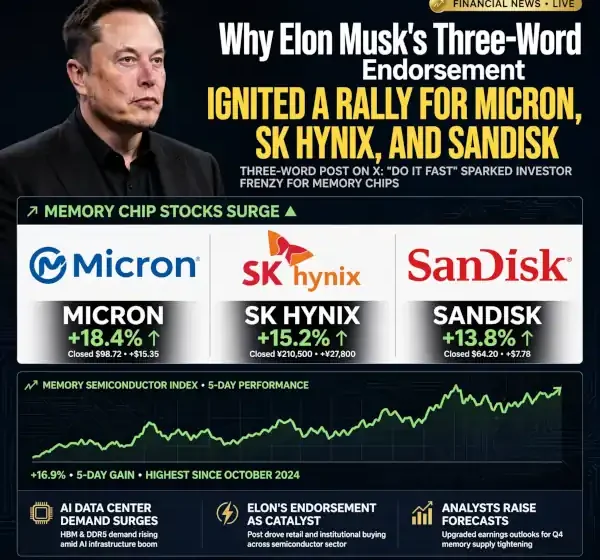
Tech mogul Elon Musk crystallised this dynamic on his social media platform X. Responding directly to technology executive and futurist Peter H. Diamandis, who posted that “Memory, not compute, is the rate limiter of the Agentic Era,” Musk offered a terse, three-word affirmation: “Few realise this.”
             ┌──────────────────────────────────────────────────────────┐
             │       THE SHIFTING BOTTLENECK IN ARTIFICIAL INTELLIGENCE │
             └──────────────────────────────────────────────────────────┘

         GENERATIVE AI ERA (2022–2025)             AGENTIC AI ERA (2026+)
         ─────────────────────────────             ───────────────────────
           Primary Need: Raw Compute                 Primary Need: Memory & Storage
           Focus: Model Training & GPUs              Focus: Long Context & Multi-Step Reasoning
           Memory View: Low-Margin Commodity         Memory View: High-Bandwidth Critical Enabler
That concise validation reverberated across global trading desks on Monday, igniting a broad-based rally across the semiconductor memory sector. Shares of Micron Technology (NASDAQ: MU), South Korea’s SK Hynix (KRX: 000660 / SKHY), and pure-play flash designer SanDisk (NASDAQ: SNDK) surged, prompting investors to re-examine whether the memory industry is poised for an extended, structural “supercycle.”
The Mid-Summer Panic and the Opportunity to Buy the Dip
The latest surge comes on the heels of a volatile summer for chip investors. Memory and storage providers staged historic runs through the first half of 2026, breaking free from their legacy reputations as cyclical, low-margin “commodity” stocks. Yet in July, the group suffered a sharp pullback.
A cocktail of headwinds rattled market sentiment:
- Profit-taking: Institutional funds rebalanced after outsized multi-quarter gains.
- Emerging Competition Fears:Speculation spread that research labs in China were engineering hyper-efficient model architectures requiring fewer physical memory channels.
- Short-Seller Skepticism: Traditional bears pointed to upcoming semiconductor fabrication expansions slated for 2028 as an indicator of an imminent supply glut.
- Hedge Fund Liquidation:The sudden blow-up and forced unwinding of the AI-focused hedge fund Situational Awareness added acute technical selling pressure to market leaders.
Even with August’s stabilization, top memory names traded between 15% and 30% below their June all-time highs heading into this week.
Musk’s commentary, coupled with bullish Wall Street research, provides substantive backing for value-oriented technology investors who view the mid-summer drawdown not as the bursting of a bubble, but as a textbook dip-buying opportunity.
Understanding the Shift: Why Agentic AI Is Starved for Memory
To understand why memory manufacturers are capturing a growing share of AI capital expenditures, one must look at how agentic AI operates differently from traditional generative models.
Early generative AI tools like basic chatbots were largely stateless: a user provided a prompt, the model generated a single completion, and the session ended. In contrast, AI agents are designed to work autonomously over prolonged periods.They break complex enterprise assignments into multi-step execution plans, leverage external software tools, run internal code execution sandboxes, evaluate outcomes, and iterate toward a goal without continuous human prompting.
                     ┌─────────────────────────────────────────┐
                     │     ANATOMY OF AN AGENTIC WORKLOAD      │
                     └─────────────────────────────────────────┘
                                          │
            ┌─────────────────────────────┼─────────────────────────────┐
            ▼                             ▼                             ▼
   [ State & KV Cache ]          [ Tool Queues & Data ]       [ Vector Search Indices ]
            │                             │                             │
   Maintains historical context  Buffers live browser/API      Accelerates high-speed
   & multi-step execution logic  outputs during tasks          retrieval-augmented search
            │                             │                             │
            └─────────────────────────────┼─────────────────────────────┘
                                          │
                                          ▼
                      ┌───────────────────────────────────────┐
                      │ REQUIRES DENSE DRAM, HBM, & NAND SSDs │
                      └───────────────────────────────────────┘
According to technical specifications published by Micron Technology, each active AI agent instance demands memory bandwidth across several distinct vectors:
- State & Key-Value (KV) Context Staging:Agents must maintain an active memory of past reasoning paths and executed steps.
- Tool Output Buffers: Intermediate data streams from web scraping, API calls, and SQL queries must be temporarily held in memory queues.
- Container and Sandbox Memory:Secure virtualized execution sandboxes require isolated memory allocations to run code safely.
- Vector and Indexing Caches: Fast retrieval-augmented generation (RAG) models rely on vector databases pinned into local memory for rapid semantic querying.
- Operating System Overhead: Running tens of thousands of autonomous agents simultaneously creates massive system runtime and OS-level memory demand.
While model training requires a high initial allocation of High Bandwidth Memory (HBM) to saturate compute clusters, the total memory required for training is fundamentally capped by the physical number of GPUs.
Inference, however, is theoretically unbounded.
As millions of enterprise agents run 24/7 autonomous operations, they must constantly read, write, and store context.A recent research note from Goldman Sachs estimates that by 2030, agentic AI systems will process over 120 quadrillion tokens per month—a 24-fold increase compared to run-rates observed in early 2026.
Company Breakdown: Who Benefits Most?
| Company | Ticker | Primary Exposure | Key Catalyst in the Agentic AI Supercycle |
| SK Hynix | KRX: 000660 / SKHY | HBM3E / HBM4 & Server DRAM | Dominant market share in advanced High-Bandwidth Memory; primary packaging partner for leading AI accelerator platforms. |
| Micron Technology | NASDAQ: MU | HBM, DRAM, & High-Density NAND | Full-stack memory portfolio spanning ultra-high-capacity server DDR5 and high-speed data center solid-state drives. |
| SanDisk | NASDAQ: SNDK | Enterprise NAND Flash & Fast SSDs | Pure-play exposure to massive context storage, offloaded KV-caching, and long-tail persistent memory tiers. |
SK Hynix: The High-Bandwidth Heavyweight
South Korea’s SK Hynix remains the acknowledged leader in High Bandwidth Memory (HBM) packaging. Advanced HBM architectures require complex 3D-stacking and Through-Silicon Via (TSV) manufacturing, consuming up to three times as much wafer capacity per bit as traditional commodity server DRAM. This structural dynamic crimps overall industry wafer supply, supporting pricing power and operating margins across SK Hynix’s memory product lines.
Micron Technology: The Balanced Play
Micron presents investors with a balanced, full-stack footprint. As one of only three global producers capable of manufacturing advanced DRAM at scale, Micron benefits directly from surging pricing across both high-density DDR5 modules and next-generation HBM architectures. Additionally, Micron’s expanding enterprise flash segment captures high-margin upside from cloud service providers provisioning data centers for agent-based workflows.
SanDisk: The Pure-Play Flash Beneficiary
While high-speed DRAM handles immediate token generation, agentic systems creating massive KV-cache histories cannot afford to keep all context loaded in expensive DRAM indefinitely.Enterprise architectures increasingly offload historical context and vector indexes onto ultra-fast enterprise NAND SSDs. SanDisk provides direct leverage to this enterprise storage wave without dilution from traditional PC or mobile end-markets.
The Horizon: A Prolonged Memory Supercycle
For decades, the memory industry was defined by brutal boom-and-bust cycles: rapid capital expenditure additions quickly led to oversupply, crashing spot prices and wiping out manufacturer profitability.
However, the agentic AI era presents distinct fundamentals.Manufacturing advanced memory requires drastically more capital equipment per bit, slowing down the pace at which new supply can hit the open market. Even as greenfield fabrication facilities begin output in 2028, skyrocketing inference demands suggest that every new bit produced will find immediate utility.
By affirming that memory is the true rate limiter of the next technological frontier, Elon Musk highlighted what semiconductor analysts have argued for months: the memory trade is no longer a short-term cyclical rebound, but a foundational pillar of artificial intelligence infrastructure.