
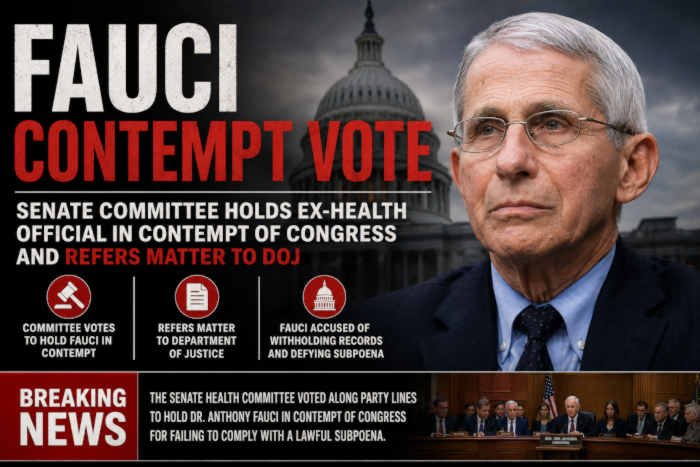

The Senate Homeland Security and Governmental Affairs Committee voted along party lines on Thursday to hold Dr. Anthony Fauci in contempt of Congress. The resolution, led by Committee Chairman Rand Paul (R-KY), passed by an 8–5 vote following a tense constitutional clash over Fauci’s refusal to testify during a hearing last week.
Chairman Paul announced that the contempt referral will be delivered directly to the U.S. Attorney’s Office for the District of Columbia and the Department of Justice (DOJ), intentionally bypassing a full Senate vote to expedite potential criminal prosecution. The action marks a dramatic escalation in the multi-year feud between the Kentucky senator and the former director of the National Institute of Allergy and Infectious Diseases (NIAID) over the government’s response to the COVID-19 pandemic.
The Fifth Amendment Standoff and Presidential Pardon Controversy
The contempt vote follows a contentious appearance before the committee last week, where Dr. Fauci invoked his Fifth Amendment right against self-incrimination more than 100 times in response to questions from Republican lawmakers. The panel’s inquiry focused on the potential laboratory origins of COVID-19, federal research grants, and pandemic-era public health measures.
At the heart of Thursday’s vote is a precedent-setting constitutional disagreement regarding presidential pardons and congressional subpoena authority:
-
The Republican Argument: Chairman Paul contended that Fauci had no legal ground to claim Fifth Amendment protections because former President Joe Biden granted Fauci a sweeping presidential pardon covering his public service prior to Biden leaving office. Paul argued that because federal criminal liability for past actions was removed by the pardon, Fauci faced “no risk of federal prosecution” and was legally obligated to answer subpoenaed questions.
-
The Defense & Democratic Argument: Fauci, his attorney David Schertler, and committee Democrats countered that the pardon did not shield him from potential state-level prosecutions or new criminal charges—such as perjury—that could arise from fresh testimony given under hostile questioning. Fauci accused Paul of orchestrating a perjury trap to fulfill public pledges to see him imprisoned.
“Dr. Fauci faced no risk of federal prosecution. All he had to do was tell the truth,” Chairman Paul stated during the hearing. “We are voting on whether a witness who has received the benefit of a sweeping pardon can be ordered by this committee to answer questions and then defy that order without consequence.”
In response, legal counsel for Fauci characterized the vote as a “crude political stunt intended to punish Dr. Fauci for exercising his constitutional rights”.
Key Arguments Division Across Party Lines
| Perspective | Key Arguments & Claims | Primary Figures |
| Committee Majority (GOP) |
• Subpoena compliance is mandatory following a federal presidential pardon.
• Congress requires full disclosure regarding pandemic origins and mandates.
• Refusal to answer questions constitutes explicit obstruction of an official investigation.
|
Sen. Rand Paul (R-KY)
Committee Republicans
|
| Committee Minority (Dems) |
• Fifth Amendment rights remain valid against potential state charges or perjury traps.
• Contempt referral sets a dangerous precedent punishing witnesses for constitutional claims.
• Inquiries serve as political retribution against a long-serving public servant.
|
Sen. Gary Peters (D-MI)
Sen. Maggie Hassan (D-NH)
|
Ranking Member Gary Peters (D-MI) strongly criticized the resolution, warning that holding a witness in contempt for asserting constitutional rights undermines legislative oversight credibility.
“The contempt resolution before us today puts all of that at risk,” Peters argued, stating that future witnesses might avoid cooperating with congressional committees altogether if basic constitutional protections are penalized.
Procedural Next Steps and DOJ Referral
Typically, a committee contempt resolution must be submitted to the full Senate for a floor vote before being referred to the Justice Department. However, Chairman Paul opted to send the referral directly to the U.S. Attorney for the District of Columbia. Paul acknowledged that a full Senate vote would face a 60-vote filibuster threshold unlikely to pass in the divided chamber.
The U.S. Attorney’s Office now holds discretionary authority to determine whether to convene a grand jury to evaluate criminal contempt of Congress charges under 2 U.S.C. § 192.
Legal scholars note that federal prosecution in this instance faces complex constitutional hurdles. Courts must evaluate whether a presidential pardon completely strips a witness of Fifth Amendment protections during subsequent congressional testimony—an untested legal boundary with wide-ranging implications for future congressional investigations and executive clemency.