
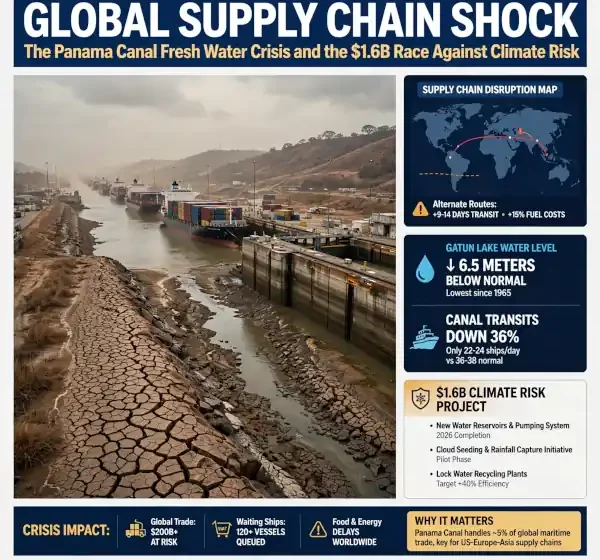

The lifeblood of international maritime commerce is running dry in an unexpected place: an artificial lake system perched 85 feet above sea level. While the Panama Canal is globally recognised as an engineering marvel connecting the Atlantic and Pacific oceans, few realise that it does not operate on seawater.
Every single vessel transit flushes roughly 50 million gallons of non-recoverable fresh water into the oceans. As climate-driven precipitation anomalies and prolonged droughts become more frequent, the Panama Canal Authority (ACP) faces an escalating crisis that threatens global freight rates, marine cargo insurance margins, and commercial shipping reliability worldwide.
The Hydrological Vulnerability of Global Maritime Logistics
The Panama Canal relies fundamentally on gravity-fed freshwater from Gatun Lake and Alhajuela Lake. Whenever a vessel enters the Panamax or Neopanamax lock chambers, massive volumes of water must be transferred to elevate and lower the ship across the continental divide.
-
Single Transit Water Expenditure: $\approx 50\text{ million gallons}$ ($190\text{ million liters}$) of freshwater per vessel.
-
Dual-Use Resource Bottleneck: The same watershed supplying the lock system provides drinking water for more than 50% of Panama’s population.
-
Neopanamax Water-Saving Basins: While newer locks feature water-recycling basins recovering around 60% of lockage volume, baseline net loss remains substantial given overall trade volumes.
When regional precipitation drops below seasonal averages, Gatun Lake levels decline precipitously. Because vessel draft clearance directly dictates the maximum safe tonnage a container ship or bulk carrier can carry, low water levels trigger aggressive operational constraints.
Commercial Impact: Draft Restrictions and Supply Chain Disruption
When the ACP enacts maximum allowable draft restrictions, cargo vessels are forced to drastically offload containers or reroute around the Cape of Good Hope, sending intermodal freight rates soaring.
| Operational Metric | Standard Capacity | Drought-Restricted Capacity | Impact on Shippers |
| Max Vessel Draft | Up to $50.0\text{ ft}$ ($15.24\text{ m}$) | Reduced to $44.0\text{–}47.5\text{ ft}$ | Loss of 300–500+ TEUs per foot of reduction |
| Daily Transit Slots | $36\text{–}38\text{ vessels/day}$ | Cut down to $18\text{–}24\text{ vessels/day}$ | Extended anchorage delays & auction slot surges |
| Spot Booking Auctions | Nominal processing fees | Millions in auction premiums | Inflated supply chain procurement costs |
| Average Wait Times | Under 48 hours | 10 to 21+ days | Escalated marine cargo insurance liabilities |
A single foot of draft reduction requires an average container ship to shed hundreds of laden containers. For logistics directors and commodity procurement desks, this bottleneck elevates spot freight rates, creates inventory shortfalls, and strains alternative intermodal corridors across North America.
The $1.6 Billion Río Indio Reservoir Solution
To secure long-term water independence through the next half-century, the ACP and engineering partners designed the Río Indio Reservoir project, a massive infrastructure endeavor valued at approximately $1.6 billion.
-
Infrastructure Scope: A 330-foot-tall concrete dam and reservoir located roughly 20 miles west of the waterway, linked by an 8-kilometer water transfer tunnel.
-
Target Delivery Timeline: Construction spans roughly six years, meaning the new reservoir will not provide active water yield until the early 2030s.
-
Legal and Legal Battles: Panama’s Supreme Court recently struck down legal constraints limiting the canal watershed, allowing reservoir planning to resume, yet local socio-environmental challenges and community displacement disputes remain central friction points.
Until the Río Indio reservoir becomes operational, global shipping lines must hedge against structural volatility with multimodal land bridges, altered route optimisation strategies, and tighter freight hedging mechanisms.