
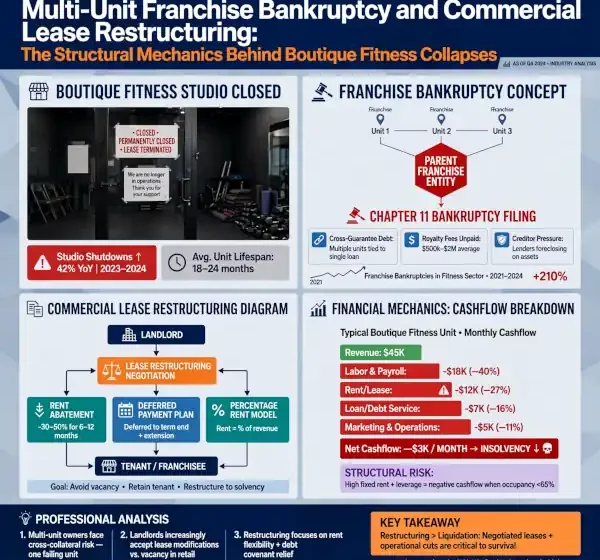

When Mad Fitness Group filed for Chapter 11 bankruptcy protection across thirty-one regional fitness locations, the structural fragility of high-density boutique studio franchising was exposed. The multi-unit filing—affecting operations spanning six states under the F45 Training umbrella—illustrates a deep economic mismatch between corporate growth incentives and unit-level operational reality. While the franchisor entity remains solvent, the operating entity carrying the physical footprint buckled under rigid overhead, compressed profit margins, and unmanageable commercial lease commitments.
Understanding why multi-unit boutique operators fail requires moving past broad macroeconomic generalities and examining the specific economic vectors governing high-intensity interval training franchises. Multi-unit franchise insolvency is rarely caused by a sudden drop in consumer interest alone. Instead, it stems from structural capital flaws, predatory financing terms, and an unsustainable scaling architecture that multiplies fixed liabilities faster than gross revenue can expand.
The Fixed-Cost Trap and Unit Economics in Boutique Fitness Franchises
Boutique fitness models operate on a high-fixed-cost architecture combined with strict physical capacity limits. Unlike traditional commercial gyms that monetise thousands of members through passive non-attendance, structured group fitness models rely on synchronised scheduling, proprietary equipment packages, and high-ratio coaching staff. When membership growth plateaus, these fixed operating costs immediately eat into operating cash flow.
The primary cost functions driving studio distress are concentrated in three key areas:
-
Real Estate Lease Liabilities: Long-term commercial real estate lease commitments featuring rigid annual rent escalation clauses, triple-net (NNN) charges, and personal guarantees tied to multi-unit master development agreements.
-
Corporate Royalty and Tech Fees: Mandatory royalty, marketing, and technology fees paid directly to the franchisor entity, which remain fixed or percentage-based on top-line gross revenue regardless of bottom-line net margin compression.
-
Scaling Labour Expenditures: Direct coaching expenditures that scale upward with every added class slot, preventing true operational leverage as membership numbers fluctuate month over month.
When an operator scales rapidly across multiple territories via multi-unit development agreements, they multiply these fixed liabilities without achieving proportional administrative efficiencies. Centralised corporate overhead—such as regional managers, multi-unit marketing coordination, and centralised accounting—adds another layer of capital drain before individual locations reach cash flow neutrality.
| Financial & Operational Metric | Big-Box Commercial Gym Model | Boutique Fitness Studio Model |
| Membership Capacity | 3,000 – 10,000+ members per facility | 150 – 350 active members per box |
| Real Estate Footprint | 25,000 – 60,000+ square feet | 2,000 – 4,000 square feet |
| Revenue Model Mechanics | High-volume passive recurring dues | High-yield active attendance & class packages |
| Labor Cost Flexibility | Low staffing ratio per active floor member | High specialised coaching staff costs per class |
| Break-Even Sensitivity | Highly resilient to attendance fluctuations | Extremely sensitive to 10%–15% member churn |
| Capital Expenditure Demand | Distributed over long equipment lifecycles | High upfront franchisor-mandated re-equips |
Cross-Collateralization Contagion: How Multi-Unit Scaling Triggers Systemic Liquidity Crises
Franchisors historically favour multi-unit operators because regional expansion happens faster when contracted through single corporate entities. However, this aggressive expansion strategy introduces a systemic vulnerability known as cross-collateralization contagion. When a single holding entity controls dozens of territories, cash flow is rarely isolated per individual studio box.
Instead, early-stage or high-performing locations are frequently leveraged to subsidise the construction, initial marketing deficits, and cash burn of newer, underperforming units. The sequential collapse of a multi-unit franchise portfolio typically follows a predictable four-stage cascade:
-
Capital Pooling & Diversion: Free cash flow generated by mature, profitable studios is diverted to fund build-outs, tenant improvements, and payroll obligations for opening territories.
-
Working Capital Depletion: Unexpected delays in new studio openings or slower-than-projected membership ramp-ups consume central reserves, leaving no buffer for unexpected economic shifts.
-
High-Cost Debt Accumulation: To maintain operational liquidity, the corporate entity secures short-term merchant cash advance financing and expensive working capital loans backed by personal or cross-collateralised corporate guarantees.
-
Portfolio-Wide Default: The debt servicing burden overwhelms the operational cash flow of healthy studios, triggering widespread default across landlord leases and master franchise agreements.
This dynamic creates a severe liquidity bottleneck. If localised saturation or economic headwinds dampen discretionary spending in even a fraction of the portfolio, the central entity bleeds liquidity to keep distressed units afloat. Eventually, the capital drain overwhelms the profitable branches, pulling the entire multi-state portfolio into formal bankruptcy proceedings.
Restructuring Under Chapter 11 Mechanics: Commercial Lease Rejection and Franchise Debt Relief
For distressed multi-unit operators, filing for small business Chapter 11 bankruptcy offers a powerful legal framework to restructure toxic liabilities while preserving core operational value. Under the United States Bankruptcy Code, debtors gain access to specialised legal provisions designed to restore financial solvency.
Section 365 of the Bankruptcy Code grants the debtor the unilateral right to assume or reject unexpired commercial leases and executory contracts. Rejecting unprofitable lease agreements capped at statutory damages allows operators to immediately shed unprofitable locations without facing catastrophic full-term lease damage claims from commercial landlords.
Furthermore, Chapter 11 proceedings enable franchisees to restructure merchant cash advance default liabilities, renegotiate franchisor royalty payment schedules, and eliminate high-interest unsecured corporate debt. By restructuring unsustainable real estate commitments and realigning unit-level cost structures, multi-unit operators can emerge from bankruptcy with a right-sized, cash-flow-positive studio footprint.
Frequently Asked Questions Regarding Multi-Unit Franchise Bankruptcy and Debt Restructuring
Why do franchisors remain solvent while multi-unit franchisee entities go bankrupt?
Franchisors collect top-line royalty fees based on gross revenues regardless of whether individual studios operate at a profit or loss. Because franchisors do not carry local real estate lease liabilities or studio-level payroll obligations, they are shielded from the direct operating losses that cause franchisee entity insolvency.
How does commercial lease rejection work in small business Chapter 11 bankruptcy?
Under Section 365 of the Bankruptcy Code, a debtor-in-possession can formally reject burdensome commercial leases. Once rejected, the lease terminates, the tenant surrenders the property, and landlord claims for remaining future rent are capped under statutory bankruptcy limits, converting them into lower-priority unsecured claims.
Can multi-unit operators exit master franchise agreements during bankruptcy restructuring?
Yes, master franchise agreements and territorial development contracts qualify as executory contracts under bankruptcy law. Operators can use Chapter 11 reorganisation to reject burdensome expansion agreements, shed underperforming territories, and retain only top-performing profitable units under renegotiated franchise terms.
Essential Strategic Takeaways for Franchise Operators, Lenders, and Commercial Landlords
Surviving the structural pressures of multi-unit fitness franchising requires strict adherence to unit-level economic discipline rather than unconstrained top-line growth. Franchisors and multi-unit operators must establish ring-fenced corporate structures that prevent cash flow contagion between mature studios and newly opening locations. Commercial real estate landlords and institutional lenders must also recognise that aggressive annual rent escalations and stacked short-term debt packages ultimately destroy tenant viability. Prioritising sustainable unit economics, conservative leverage, and flexible lease terms remains the only reliable defence against multi-unit studio collapses in an evolving economic landscape.
For additional analysis on commercial business trends and industry discussions, explore the updates at usa.freelatestjobalert.com/googlesearch and join ongoing strategy conversations at NTLiveNews Forums. To better understand the legal framework governing corporate reorganisations and lease rejections, review the detailed legal definitions provided in the Wikipedia Chapter 11 Overview.