Power Grid Emergency Order: Federal Authorities Intervene to Protect Oklahoma and 17 States Amid Relentless Heat Waves

Executive Summary
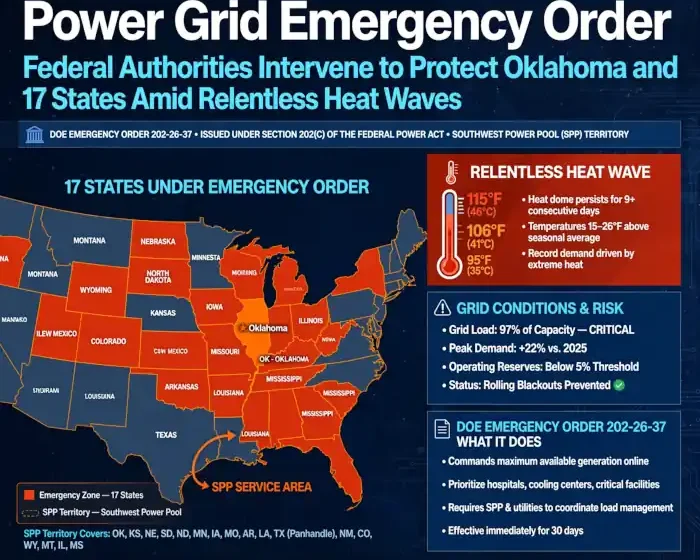
- Federal Intervention: On Sunday, July 26, 2026, the U.S. Department of Energy (DOE) issued Emergency Order No. 202-26-37 under Section 202(c) of the Federal Power Act.
- Regional Scope: The order grants emergency operating flexibility to Southwest Power Pool Inc. (SPP), covering 20 million residents across Oklahoma and 16 other states from North Dakota down to Louisiana.
- Key Measure: SPP holds authorization to tap into specified backup generation facilities as a last line of defense before declaring an Energy Emergency Alert 3 (EEA 3) or resorting to rolling blackouts.
- Duration: The order took effect immediately upon issuance and remains active through 11:59 p.m. CDT on Monday, Aug. 3, 2026.
- Underlying Stressors: Consecutive regional heat waves, record summer peak cooling demands, and rapidly expanding power draw from artificial intelligence (AI) infrastructure and data centers.
Federal Action Prevents Regional Outages
The U.S. Department of Energy (DOE) stepped in this week with extraordinary emergency measures aimed at keeping electricity flowing across Oklahoma and the broader central United States. As back-to-back heat waves push temperatures and heat indices into triple digits across the Midwest and Southern Plains, federal energy officials issued a critical directive authorising regional grid managers to deploy reserve power units to prevent widespread blackouts.
The directive targets Southwest Power Pool Inc. (SPP), the regional transmission organisation responsible for balancing electric power supplies across 17 states. Issued on Sunday, July 26, 2026, Emergency Order No. 202-26-37 permits SPP operators to dispatch designated backup generation resources
The order serves as an essential legal safety valve for grid operators. Under standard market and environmental guidelines, certain auxiliary generation units—such as older thermal facilities or localised industrial diesel generators—face strict operational hours or emissions caps. The federal order temporarily suspends those regulatory constraints during heat emergencies, giving grid dispatchers immediate access to auxiliary megawatts.
Federal officials emphasised that tapping into reserve assets provides an essential buffer against sudden voltage drops or unpredictable equipment failures. Without federal intervention, localised generation deficits could force SPP to declare an Energy Emergency Alert Level 3 (EEA 3), triggering controlled, rolling blackouts to prevent total system collapse.
Oklahoma Faces Sustained Heat Dome
For Oklahomans, federal intervention comes as severe high-pressure “heat domes” lock scorching air over the Southern Plains.
Temperatures across central and western Oklahoma regularly surpassed 100°F during late July, driving heat indices past 110°F in metropolitan areas like Oklahoma City and Tulsa. AccuWeather’s long-range forecasts show elevated temperatures continuing into August, offering little overnight atmospheric cooling.
When overnight temperatures remain elevated, residential and commercial air conditioning units operate continuously. This relentless baseload consumption prevents substation equipment and neighbourhood transformers from cooling, significantly increasing the likelihood of localised hardware failures on top of broad regional generation stress.
Local utilities, including Oklahoma Gas and Electric (OG&E) and Public Service Company of Oklahoma (PSO), coordinate continuously with SPP to manage energy flow. While distribution lines deliver electricity to individual homes, SPP’s central control room directs high-voltage transmission lines to maintain a precise regional supply-demand equilibrium.
Southwest Power Pool Manages Multi-State Grid Strain
Headquartered in Little Rock, Arkansas, SPP oversees a massive geographic footprint extending from North Dakota down to northern Louisiana, spanning 17 states and serving 20 million consumers. Balancing energy across this territory requires constant coordination between dispatchable power sources—such as natural gas, nuclear, and coal plants—and variable renewables like wind and solar.
During extreme summer heat waves, SPP confronts two simultaneous operational hurdles:
- Surging Air Conditioning Loads: High temperatures create record peak electricity consumption during late afternoon hours.
- Stagnant Wind Generation: Heat domes frequently bring calm, low-wind weather patterns. When wind output drops across the Great Plains, grid operators must compensate by ramping up conventional thermal generation.
On July 24, SPP issued an Energy Emergency Alert Level 2 (EEA 2) for its West Balancing Authority Area—which includes Oklahoma—signalling that operators had committed all available regular generation resources and initiated demand-response programs. The subsequent federal 202(c) order supplies the next critical layer of backup security, allowing SPP to call upon reserve units before resorting to rolling outages.
Structural Drivers: AI Data CCentres and Dual-Season Demand
While record temperatures trigger immediate grid emergency orders, structural changes in national energy consumption are reducing the system’s baseline safety margins.
Energy analysts and recent industry reports highlight several key drivers reshaping power demand:
- Expanding Data Centre Footprint: Rapid growth in artificial intelligence (AI) facilities, hyperscale cloud computing, and massive data centres adds huge, continuous baseload demands to regional power grids.
- Year-Round Demand Spikes: Although summer air conditioning drives peak demand in southern states, winter heating demands have also increased steadily year over year. This dual-season stress narrows the spring and autumn maintenance windows that power plants traditionally use for repairs.
- Ageing Infrastructure Stress: Transmission networks and transformer stations experience heightened thermal wear when carrying high electrical current during hot ambient weather.
Because data centre loads remain high 24/7, grid operators possess less spare capacity when high residential cooling demands hit the system during hot summer afternoons.
Consumer Energy Actions and Looking Ahead
While federal intervention provides SPP with necessary operational flexibility, power companies still encourage consumers to take simple conservation steps to relieve local distribution lines.
Effective Household Energy Conservation Steps
- Adjust Thermostats: Setting thermostats to 78°F or higher during peak afternoon hours (2:00 PM to 7:00 PM) eases demand on local transformers.
- Shift Appliance Usage: Running dishwashers, clothes dryers, and washing machines during cooler morning or late evening hours reduces home heat gain and lowers peak grid load.
- Block Direct Sunlight: Closing blinds, drapes, or shades on south- and west-facing windows keeps indoor spaces significantly cooler.
- Utilise Ceiling Fans: Running ceiling fans counterclockwise creates a cooling draft while rooms are occupied.
Emergency Order No. 202-26-37 remains active through 11:59 p.m. CDT on Monday, Aug. 3, 2026. State utility commissions and federal energy regulators continue monitoring real-time load conditions to determine whether additional extensions or operational directives will be needed as summer progresses.