
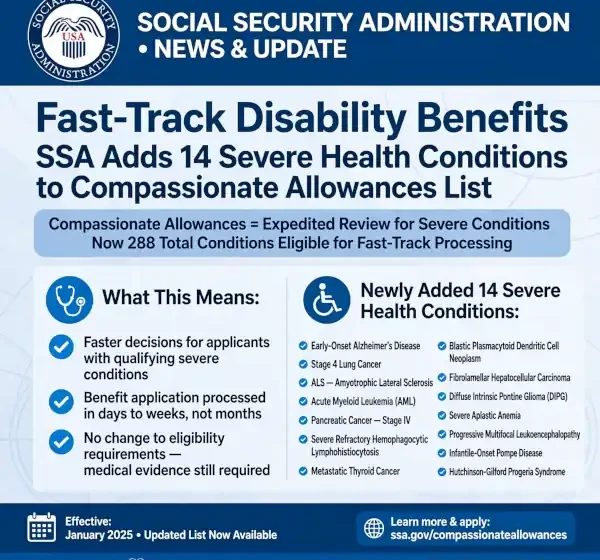

GWYNN OAK, Md. — The Social Security Administration (SSA) officially expanded its Compassionate Allowances (CAL) list, adding 14 severe medical conditions to accelerate disability benefit approvals for individuals facing life-changing, acute diagnoses. Announced by SSA Commissioner Frank J. Bisignano, this initiative cuts administrative delays for patients diagnosed with aggressive cancers, rare pediatric disorders, and severe neurological conditions.
With these 14 additions, the Compassionate Allowances program encompasses 314 qualifying conditions. Since its launch in 2008, the initiative has helped over 1.2 million Americans receive expedited financial support when battling severe health crises.
What Is the Social Security Compassionate Allowances Initiative?
The Compassionate Allowances program acts as a fast-track framework within the Social Security Administration’s disability determination process. Standard applications for Social Security Disability Insurance (SSDI) or Supplemental Security Income (SSI) require extensive administrative review, employment history verification, and medical evaluations—a process taking six to eight months.
For individuals facing stage-four cancers, degenerative brain disorders, or catastrophic childhood genetic conditions, waiting half a year for financial relief causes severe hardship. The Compassionate Allowances program bypasses standard bureaucratic backlogs. Advanced software scans incoming applications for flagged diagnoses. When medical records confirm a match, the SSA approves benefits in days or weeks rather than months
Breakdown of the 14 Newly Added Health Conditions
The newly added medical conditions fall into three core clinical categories: aggressive cancers, rare genetic disorders affecting children, and progressive neurological conditions.
1. Rare Pediatric & Genetic Disorders
-
Adenylosuccinate Lyase Deficiency (Neonatal Form and Type 1): A rare metabolic disorder that severely impairs purine metabolism, leading to severe neurological dysfunction, seizures, and psychomotor delay in infants.
-
Aicardi Syndrome: A rare genetic condition occurring almost exclusively in females, characterized by the absence of the structure connecting the brain’s hemispheres (corpus callosum), infantile spasms, and retinal lesions.
-
Baraitser-Winter Syndrome: A rare developmental disorder marked by distinct facial features, structural brain malformations, muscle weakness, and intellectual disability.
-
Beare-Stevenson Cutis Gyrata Syndrome: A rare genetic disorder characterized by skin abnormalities—specifically deep furrowed corrugations on the scalp—and premature skull bone fusion (craniosynostosis).
-
Bohring-Opitz Syndrome: A severe genetic condition characterized by distinctive body posture, severe intellectual disability, microcephaly, and feeding difficulties from birth.
-
CASK-Related Gene Disorders: Genetic mutations in the CASK gene that cause microcephaly, brain malformations, severe developmental delays, and optic nerve atrophy.
-
OPHN1 Syndrome: An X-linked neurodevelopmental disorder causing intellectual disability, low muscle tone (hypotonia), and cerebellar malformations.
-
Warburg Micro Syndrome: An autosomal recessive genetic disorder marked by microcephaly, eye abnormalities (such as congenital cataracts), and severe developmental delay.
2. Neurological & Seizure Disorders
-
Lafora Disease: A fatal form of progressive myoclonus epilepsy characterized by recurrent seizures, rapidly worsening dementia, and severe muscle spasms beginning in adolescence.
-
Malignant Migrating Partial Seizures of Infancy (MMPSI): A severe form of early-onset epilepsy where continuous, shifting focal seizures begin in early infancy, leading to profound developmental stagnation.
3. Aggressive Cancers
-
Hepatosplenic T-Cell Lymphoma: An extremely rare and aggressive non-Hodgkin lymphoma that impacts the liver, spleen, and bone marrow.
-
Primary Cardiac Sarcoma: A rare malignant tumor arising directly in the heart that rapidly impairs cardiovascular function.
-
Primary Intracranial Malignant Melanoma: An aggressive central nervous system cancer arising directly from melanocytes within the meninges covering the brain.
-
Uveal Melanoma (with Metastases): An ocular cancer originating in the eye that spreads to distant organs, most commonly the liver.
Comparing Disability Review Pathways
Key differences between a standard Social Security disability review and a Compassionate Allowance review center on processing velocity, documentation thresholds, and initial screening methods.
| Application Feature | Standard SSDI / SSI Review | Compassionate Allowances (CAL) Process |
| Average Processing Time | 6 to 8 months | Days to a few weeks |
| Medical Evidence Threshold | Longitudinal work history and functional capacity reviews | Definitive diagnostic confirmation (pathology, genetic testing, imaging) |
| Initial Screening Method | Manual caseworker assignment and regional medical review | Automated electronic software scanning incoming claims |
| First-Review Approval Rate | Varied (often requires appeals or administrative hearings) | Exceptionally high upon clear diagnostic verification |
| Total Covered Conditions | Broad functional impairments evaluated case-by-case | 314 explicitly designated high-severity diagnoses |
How Health Conditions Enter the CAL Pipeline
The Social Security Administration relies on structured inter-agency collaborations to evaluate potential conditions. Medical experts, federal research institutions, patient advocates, and the public contribute directly to expanding the CAL list.
-
Public & Expert Nominations: Advocates, physicians, and patients submit condition proposals via the online SSA portal.
-
Inter-Agency Consultation: The SSA coordinates with the National Institutes of Health (NIH), the National Organization for Rare Disorders (NORD), and specialized medical boards.
-
Public Outreach Hearings: The agency conducts public listening sessions focusing on specific rare diseases, pediatric disorders, and cancer sub-types.
-
System Implementation: Approved medical conditions receive specific diagnostic codes, updating the automated screening algorithms.
Frequently Asked Questions (FAQs)
Do I need to submit a separate application for a Compassionate Allowance condition?
No. The SSA uses one universal application for Social Security Disability Insurance (SSDI) and Supplemental Security Income (SSI). The agency’s electronic intake technology automatically identifies conditions on the Compassionate Allowances list through diagnostic keywords and medical codes.
How fast does the SSA approve Compassionate Allowance claims?
While typical claims take six to eight months, CAL-flagged applications receive approval within weeks or even days. Speed depends on submitting complete medical records upfront.
Does a Compassionate Allowance diagnosis guarantee disability benefits?
A CAL diagnosis guarantees fast-track review, but applicants must still meet basic statutory requirements. Medical records must confirm the exact diagnosis, and applicants must meet non-medical eligibility criteria (such as work credit history for SSDI or financial limits for SSI).
Can children qualify for fast-track disability under CAL?
Yes. Many conditions on the list—including newly added genetic disorders like Aicardi syndrome and Warburg micro syndrome—primarily affect infants and children. Children receive benefits through the Supplemental Security Income (SSI) program.
What medical records should applicants attach to a CAL application?
Applicants should submit definitive diagnostic documentation immediately. Necessary records include genetic sequencing reports, tissue biopsy results, surgical pathology, neuroimaging (MRI/CT scans), and treatment summaries from attending medical specialists.
Filing a Social Security disability claim during a severe health crisis demands speed and accuracy. Including clear diagnostic reports with an initial submission ensures automated system filters flag qualifying claims immediately, delivering necessary financial support without unnecessary delays.