
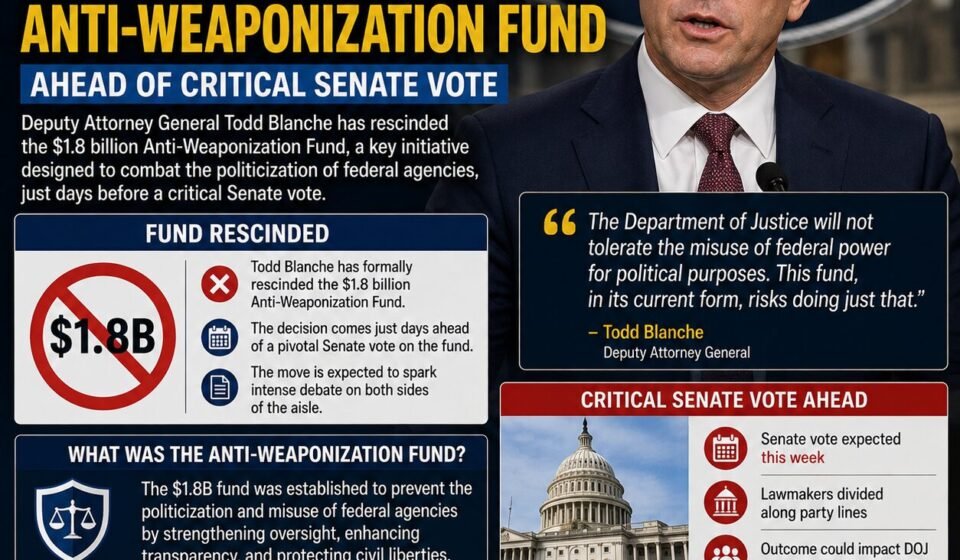

WASHINGTON: Todd Blanche Rescinds Controversial $1.8 Billion ‘Anti-Weaponisation Fund’ in High-Stakes Confirmation Battle. In a dramatic late-night manoeuvre aimed at salvaging his nomination for United States Attorney General, Acting Attorney General Todd Blanche officially issued an executive order rescinding the Department of Justice’s controversial $1.8 billion “Anti-Weaponisation Fund”.
The decision comes as the U.S. Senate reconvenes for its final high-stakes session before entering its late-summer recess. Blanche’s formal order removes a primary legislative hurdle that had stalled his Senate Judiciary Committee confirmation, though key questions surrounding a related Internal Revenue Service (IRS) tax settlement continue to linger over Capitol Hill.
Simultaneously, the White House continues to adjust its geopolitical posture, with President Donald Trump pulling back from proposed military strikes against Iran, shifting focus toward economic leverage and diplomatic manoeuvring in the Middle East.
The Rescindment Order: Paving the Path to Confirmation
The official rescission order, issued late Sunday evening, formally cancels the May 18, 2026, administrative order that established the $1.8 billion fund. Originally framed by administration officials as a mechanism to compensate individuals alleging political persecution or “weaponisation” by federal agencies, the initiative drew immediate and fierce opposition from lawmakers on both sides of the aisle.
In his statement released alongside the order, Blanche emphasised that the fund was never operationalized:
“The Department always welcomes and appreciates productive engagement with all members of Congress. For the avoidance of doubt, nothing in this Order is intended to contradict prior representations… No members were appointed; no funds were transferred; no process for receiving claims was established; no claims were paid. Today’s order establishes, beyond any doubt, that there is no fund.”
Despite Blanche’s prior testimony before Congress asserting that the fund was dormant, key Senate Republicans refused to move forward without a legally binding, written termination.
Republican Resistance on the Judiciary Committee
The primary pushback came from two influential members of the Senate Judiciary Committee: Senator John Cornyn of Texas and Senator Thom Tillis of North Carolina. With Republicans holding a razor-thin 11-10 majority on the committee, a single dissenting GOP vote threatened to derail Blanche’s path to becoming the nation’s chief law enforcement officer.
-
Senator John Cornyn (R-TX) demanded absolute written assurance that federal tax dollars would not be diverted into non-standard compensation accounts.
-
Senator Thom Tillis (R-NC): Expressed deep scepticism regarding the precedent set by the fund, privately and publicly pressing Blanche to “stick a fork” in the program before any committee vote.
With the formal rescindment now signed, committee leaders indicate a confirmation vote could move forward as early as Tuesday.
The Origins: IRS Lawsuit and Audit Exemption Clause
The roots of the “Anti-Weaponisation Fund” stem from a landmark settlement resolving a civil lawsuit filed by Donald Trump against the IRS and the Department of the Treasury over leaked confidential tax returns.
While the $1.8 billion compensation framework has been dismantled, legal observers note that Sunday’s order only partially addresses the broader implications of the May settlement.
┌─────────────────────────────────────────────────────────────────────────┐
│                        MAY 2026 IRS SETTLEMENT                          │
├────────────────────────────────────┬────────────────────────────────────┤
│     Anti-Weaponization Fund        │      Tax Audit Immunity Scope      │
│            ($1.8B)                 │                                    │
├────────────────────────────────────┼────────────────────────────────────┤
│ • Intended for alleged targets     │ • Covers past/open IRS claims      │
│ • Rescinded by Blanche Aug 3  │ • Clarified to exclude future      │
│ • Declared officially dead    │   tax return filings              │
└────────────────────────────────────┴────────────────────────────────────┘
The document released by Blanche clarifies that provisions offering audit protections to President Trump and his family members apply only retroactively to open claims active at the time of the settlement. It explicitly confirms that future tax filings remain subject to standard IRS review processes.
However, critics and Senate Democrats argue that granting retroactive audit exemptions sets an unprecedented administrative benchmark. Senatorial legal aides continue to scrutinise the remaining language as floor debates draw near.
Foreign Policy Pivot: De-escalation with Iran
While domestic attention remains fixed on the Department of Justice leadership fight, White House officials confirmed a significant foreign policy shift overnight. President Trump has called off scheduled military strikes against targets inside Iran.
The proposed strikes had been weighed following escalating regional friction and intelligence reports regarding proxy activity in the Middle East. However, administration sources indicate the decision to stand down was made after national security advisors outlined diplomatic alternatives and incoming economic sanctions.
Key factors influencing the administration’s stance include:
-
Backchannel Communications: European allies reportedly facilitated direct communications, opening potential avenues for updated nuclear containment talks.
-
Economic Sanctions Integration: The administration is choosing to double down on strict enforcement of maritime trade restrictions rather than immediate kinetic actions.
-
Regional Stability Risks: Military leaders cautioned that direct kinetic engagements could trigger widespread disruptions across global oil shipping routes.
The pivot reflects a broader strategy to avoid prolonged foreign entanglements, while the executive branch focuses on domestic policy implementations and judicial confirmations before Congress adjourns for recess.
Political Outlook: What Lies Ahead for Capitol Hill?
As the Senate enters its final week before the mid-August recess, the calendar is packed with judicial nominations, executive appointments, and spending measures.
                      UPCOMING SENATE TIMELINE

  August 3             August 4-5           Mid-August
  ────────             ──────────           ──────────
  Senate returns       Judiciary Committee  Senate enters
  from weekend         vote on Blanche      summer recess
  recess               nomination           until Sept
For Todd Blanche, rescinding the fund removes his largest public liability. Yet, floor confirmation remains a numbers game. With tight party margins, Senate Majority leadership must ensure full attendance to confirm the Acting Attorney General without relying on bipartisan crossover votes.
If confirmed, Blanche faces the immediate task of stabilizing a Department of Justice that has experienced months of leadership transitions, intense congressional oversight, and high-profile legal debates over the boundaries of executive authority.
Essential Terminology & Key References
-
Todd Blanche: Current Acting Attorney General and nominee to permanently lead the U.S. Department of Justice.
-
Internal Revenue Service (IRS): The U.S. government agency responsible for tax collection and tax law enforcement.
-
United States Department of Justice: The federal executive department responsible for the enforcement of law and administration of justice.