
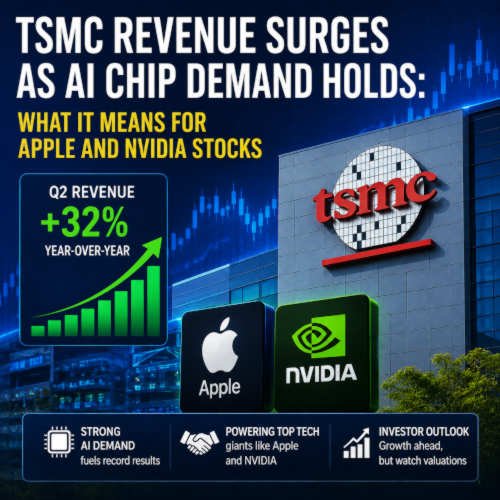

USA Business updates today : Taiwan Semiconductor Manufacturing Co. (TSMC), the irreplaceable backbone of global technology hardware, does not host flashy webcasts or release lengthy commentary when it unveils its monthly revenue figures. There is no executive chairman walking analysts through the line items, no Q&A session, and no attempt to control the narrative. The company simply publishes a single financial total.
Yet, the entire global technology landscape—from Wall Street portfolio managers to Silicon Valley chip designers—reads that single number like financial scripture. Because TSMC is the exclusive foundry that machines Nvidia’s market-dominating AI accelerators, manufactures custom silicon for Alphabet’s Google, and crafts the sophisticated processors inside Apple’s iPhones and MacBooks, TSMC’s monthly invoice serves as the ultimate ground-truth indicator for the global tech supply chain.
The latest receipt for July 2026 arrived with an unmistakable message: the artificial intelligence boom is not slowing down.
A Record-Breaking July: Reading the Silicon Scripture
TSMC reported consolidated net revenue for July 2026 of approximately NT$467.58 billion (roughly $14.5 billion to $16.03 billion USD depending on exchange rate fluctuations), representing a staggering 44.7% surge compared to July 2025. On a month-over-month basis, July revenue climbed 5.6% over June 2026—which itself had previously set a record.
For the first seven months of 2026 combined, TSMC’s cumulative revenue reached NT$2.87 trillion, marking a 37% expansion compared to the same period a year earlier.
These results extend a relentless growth streak powered by High-Performance Computing (HPC), the division where TSMC classifies hardware used for AI, data centres, and advanced server clusters. During TSMC’s second-quarter earnings release last month, management revealed that HPC accounted for 66% of total company revenue. In response to unrelenting demand, TSMC Chairman C.C. Wei described AI appetite as “extremely robust”—the highest form of praise in TSMC’s traditionally understated vernacular.
Crucially, TSMC guided full-year 2026 U.S. dollar revenue growth to slightly above 40%, while raising its capital expenditure budget to an eye-watering $60 billion to $64 billion.
Selling Narrative vs. Buying Chips
TSMC’s record print stands in stark contrast to the mood on Wall Street. Over the six weeks leading up to August 2026, semiconductor stocks underwent a sharp correction driven by market anxieties that Big Tech’s AI capital expenditure had run too far ahead of near-term monetisation.
The PHLX Semiconductor Index (SOX) slid approximately 15% from its June highs as traders routinely took profits and penalized chipmakers at the slightest hint of noise. Last week, Advanced Micro Devices (AMD) saw its stock tumble 8% despite doubling its data centre revenue, demonstrating how jumpy investors have become.
However, TSMC’s hard invoice data proves that while Wall Street has been selling the story of an AI slowdown, hyperscalers and hardware giants are continuing to buy the actual physical product at unprecedented volumes.
Even with recent pullbacks, the underlying fundamentals remain historically strong. The semiconductor index remains up roughly 72% for the year, while TSMC’s stock has surged more than 50% year-to-date. Profit-taking during a multi-year bull run is standard market behaviour; it does not mean chip orders are drying up.
What TSMC’s Surging Sales Mean for Nvidia ($NVDA)
For Nvidia ($NVDA), TSMC’s stellar July numbers provide the clearest possible reassurance ahead of its upcoming earnings report.
Nvidia operates as a fabless semiconductor company, relying entirely on TSMC’s advanced packaging (CoWoS – Chip-on-Wafer-on-Substrate) and leading-edge nodes (3nm and 4nm) to manufacture its flagship graphics processing units (GPUs). When TSMC’s HPC division grows at 66% and monthly revenue spikes 44.7%, Nvidia is the single largest contributor to that expansion.
The data directly refutes fears that hyperscale cloud providers are cutting back on GPU orders. Because chip production cycles at TSMC require three to four months from wafer start to final packaging, TSMC’s July revenue reflects physical orders placed by Nvidia to satisfy delivery commitments stretching well into the second half of 2026. For Nvidia shareholders, TSMC’s print confirms that Nvidia’s revenue engine is operating at maximum capacity.
What TSMC’s Surging Sales Mean for Apple ($AAPL)
While AI hardware dominated headline growth, TSMC’s July revenue figures also carry significant positive implications for Apple ($AAPL). Historically, Apple has been TSMC’s single largest customer, typically commanding exclusive first-run access to new manufacturing nodes.
As the tech sector transitions toward autumn product launch cycles, TSMC’s month-over-month revenue increase (+5.6% from June) signals that seasonal silicon ramp-ups for upcoming consumer devices are progressing at full scale.
Furthermore, Apple’s push into on-device AI requires dense, energy-efficient chips built on 3nm and emerging 2nm architectures. TSMC’s ability to generate record revenues while simultaneously funding a $60B+ capital expenditure program ensures that Apple will have the node capacity and technical precision required to roll out AI features across hundreds of millions of flagship devices.
The Broader Impact on Big Tech and Custom Silicon
Beyond Nvidia and Apple, TSMC’s July receipt highlights a broader structural transformation across the technology sector: the rise of custom AI silicon.
Hyper-scalers like Google (TPUs), Amazon (Trainium/Inferentia), and Meta (MTIA) are increasingly designing proprietary chips to reduce their dependence on off-the-shelf accelerators. However, regardless of who designs the chip, almost all of them rely on TSMC for fabrication.
Looking Ahead: Why the AI Trade Has Physical Legs
Market sentiment can shift every week as macroeconomic indicators fluctuate and traders debate valuation metrics. However, manufacturing data provides grounded clarity amid financial noise.
TSMC does not manufacture microchips speculatively; every wafer processed in its Hsinchu or Tainan fabs is backed by binding purchase orders from the wealthiest technology corporations on Earth. A record NT$467.58 billion monthly print is not a theoretical projection—it represents actual cash paid by technology leaders to secure physical hardware.
For investors holding shares in Nvidia, Apple, or TSMC itself, July’s revenue release provides clear evidence: while equity prices may experience temporary turbulence, the fundamental demand powering artificial intelligence and advanced computing remains exceptionally strong.
Here are frequently asked questions (FAQs) addressing TSMC’s record-breaking revenue figures and what they mean for major tech stocks like Apple and Nvidia.
Frequently Asked Questions (FAQs)
1. Why is TSMC’s monthly revenue report considered so critical for the entire tech market?
TSMC (Taiwan Semiconductor Manufacturing Co.) is the world’s leading pure-play chip foundry. Rather than designing consumer-facing products, it manufactures chips for major tech companies, including Nvidia, Apple, Google, and AMD. Because TSMC sits at the root of the global hardware supply chain, its monthly sales figures serve as an early, unvarnished indicator of physical product demand across the entire semiconductor and technology sector.
2. What were the key highlights from TSMC’s July 2026 revenue release?
For July 2026, TSMC reported consolidated revenue of NT$467.58 billion (approximately $14.5 billion USD):
-
Year-over-Year Growth: An increase of 44.7% compared to July 2025.
-
Month-over-Month Growth: Up 5.6% from June 2026.
-
Cumulative Growth: Cumulative revenue for the first seven months of 2026 reached NT$2.87 trillion, up 37% year-over-year.
-
Full-Year Outlook: TSMC raised its full-year 2026 revenue guidance to over 40% growth in U.S. dollar terms and boosted its 2026 capital expenditure (capex) target to between $60 billion and $64 billion.
3. What does TSMC’s growth signal for Nvidia ($NVDA)?
Nvidia relies heavily on TSMC’s advanced manufacturing nodes (3nm/4nm) and advanced Chip-on-Wafer-on-Substrate (CoWoS) packaging to produce its market-leading AI graphics processing units (GPUs). High Performance Computing (HPC)—the segment housing AI chip orders—accounts for 66% of TSMC’s revenue. TSMC’s massive sales spike indicates that hyperscale cloud providers continue to order Nvidia hardware at full capacity, directly counter-messaging Wall Street fears of an AI infrastructure slowdown.
4. How does this development impact Apple ($AAPL)?
Apple is historically TSMC’s largest customer for consumer silicon. The sequential month-over-month revenue growth (+5.6%) signals that seasonal production runs for next-generation iPhone processors (A-series) and Mac chips (M-series) are running at full scale. TSMC’s expansion of capital expenditure guarantees the wafer capacity Apple needs to execute its long-term hardware and on-device AI strategies.
5. Why did chip stocks sell off recently if TSMC’s sales are growing?
In the weeks leading up to August 2026, indices like the PHLX Semiconductor Index experienced pullbacks (~15%) due to investor anxiety over whether Big Tech was overspending on AI infrastructure before seeing immediate returns. However, stock market corrections often reflect short-term profit-taking after multi-year rallies rather than operational declines. TSMC’s physical billings show that real-world hardware demand remains exceptionally high.
Explore Related Coverage & Resources
-
Have questions about market coverage or news tips? Visit our internal Contact Page.
-
Looking for specific articles, ticker breakdowns, or archived stock reports? Use our internal Site Search Tool.
-
For detailed global technology and semiconductor research, check out the Semiconductor Industry Association (SIA).
To better understand how market updates and earnings reports impact semiconductor stocks like TSMC, this analysis breaks down the key factors driving high-performance chip demand:
This video provides an in-depth breakdown of TSMC’s financial results, capital spending plans, and what its surging growth means for broader AI technology investments.