
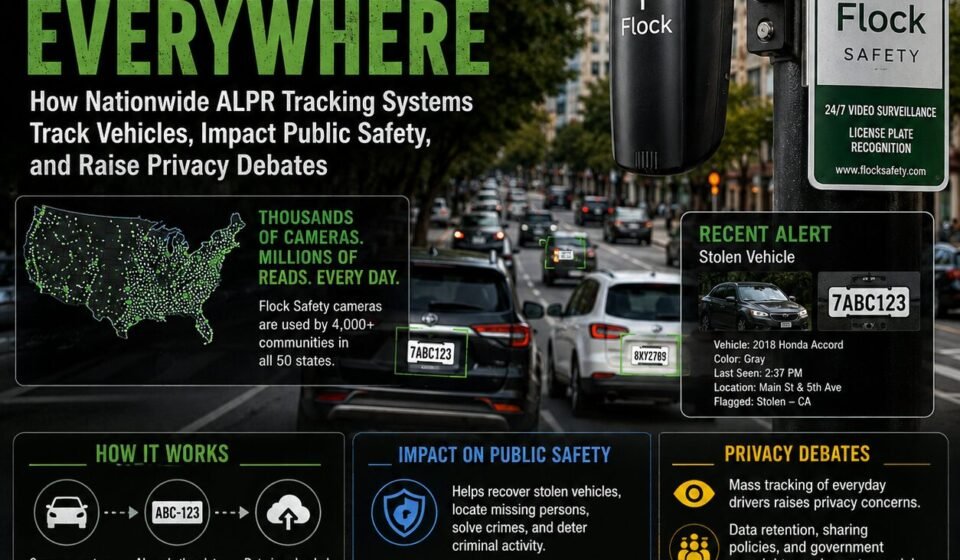

Across thousands of American neighbourhoods, suburban intersections, shopping centers, and highway corridors, small black cameras mounted on solar-powered posts operate silently 24 hours a day. Manufactured by Flock Safety, these automated license plate reader (ALPR) devices have rapidly transformed from specialized law enforcement technology into ubiquitous public safety surveillance networks. Operating in over 5,000 communities spanning 49 states, the network logs more than 20 billion vehicle scans every single month.
While traditional CCTV security systems record continuous video feeds requiring manual oversight, Flock Safety cameras utilise advanced computer vision and machine learning algorithms to index, categorise, and archive vehicle movements into searchable databases in real time.
How the AI Tracking Engine Decodes Every Passing Motor Vehicle
At the core of Flock Safety’s infrastructure is a high-speed optical capture system connected via cellular LTE networks and powered by integrated solar panels. Designed to blend into residential and commercial environments, these cameras can capture clear, actionable vehicle data even when vehicles travel at speeds up to 100 mph from up to 75 feet away.
When a car passes through a camera’s field of view, the system records much more than a standard license plate number:
-
Vehicle Signature Technology: Uses machine learning to identify specific attributes including make, model, body type, and paint color.
-
Distinguishing Characteristics: Identifies unique features such as roof racks, bumper stickers, aftermarket spoilers, custom wheels, or missing body panels.
-
Plate Anomaly Detection: Reads temporary tags, paper plates, obscured numbers, and missing rear plates.
-
Geospatial & Time Stamping: Tags every entry with precise GPS coordinates, direction of travel, and exact timestamps.
This “vehicle fingerprint” capability allows investigative search queries even when a witness or victim cannot provide a full license plate number. Investigators can input vague descriptions—such as “red pickup truck with a ladder rack”—and receive immediate historical hits across local or regional camera networks.
Crime Deterrence, Auto Insurance, and Property Protection
The deployment of Flock Safety hardware extends far beyond municipal police departments. Homeowners association (HOA) security committees, apartment complex property managers, and retail businesses increasingly lease these ALPR systems to enhance commercial property protection and deter neighborhood property crimes.
| Key Feature | System Capability & Function | Primary Operational Benefit |
| Hot List Instant Alerts | Syncs with national crime databases (NCIC) and custom police watchlists. | Instant alerts sent to patrol units when a stolen vehicle or suspect enters an area. |
| Vehicle Attribution | Indexes color, body type, modifications, and partial plate text. | Enables fast case-building even without a full plate number. |
| Shared Network Access | Interconnects private HOA and business cameras with local law enforcement. | Coordinates rapid cross-jurisdictional response across district boundaries. |
For insurance providers and victims of auto theft, real-time ALPR networks serve as a critical tool for asset recovery. Stolen vehicles are often classified as “keystone crimes” because perpetrators frequently utilize stolen automobiles to facilitate secondary offenses such as burglaries and armed robberies. By triggering automated alerts when a flagged vehicle passes a camera, law enforcement can intervene quickly—often aiding in fast vehicle recovery that reduces auto insurance claims and liability losses.
Privacy Debates, Legal Battles, and Civil Rights Questions
Despite widespread adoption by law enforcement and private security managers, the rapid expansion of Flock Safety networks has drawn scrutiny from civil liberties organizations, privacy advocates, and criminal defense attorney associations.
Critics argue that aggregating billions of location data points creates an unprecedented, searchable map of routine civilian travel. Opponents contend that mass automated surveillance can track individuals visiting medical facilities, political rallies, religious institutions, or private residences without individualised reasonable suspicion or a judicial warrant.
To address these privacy concerns, Flock Safety emphasises several core safeguards built into its platform governance:
-
Short Retention Windows: Data captured by default is automatically deleted after 30 days unless tagged as active evidence in an ongoing criminal investigation.
-
No Facial Recognition: Cameras are angled to capture vehicle exteriors and license plates rather than passenger faces, and software does not execute facial recognition or driver identification.
-
Audit Trails & Search Reasons: Every search conducted by law enforcement requires a documented case number or investigative reason, creating an immutable audit log to prevent system misuse.
-
No Traffic Enforcement: Systems are not used to issue speed citations or red-light moving violation fines.
Nevertheless, ongoing civil rights lawsuits and state-level legislative debates continue to question whether long-term tracking via interconnected ALPR grids violates Fourth Amendment protections against unreasonable searches.
The Future of Smart City Surveillance
As local municipalities, enterprise businesses, and law enforcement agencies invest further in smart city technology, Flock Safety continues expanding its ecosystem into integrated video streams, audio gunshot detection, and drone-assisted first response platforms.
For modern communities, the technology offers a balance between proactive crime prevention and public accountability. Whether viewed as a force multiplier for police departments or an expanding surveillance footprint, Flock Safety cameras have permanently altered how vehicle activity is monitored across the American landscape.