
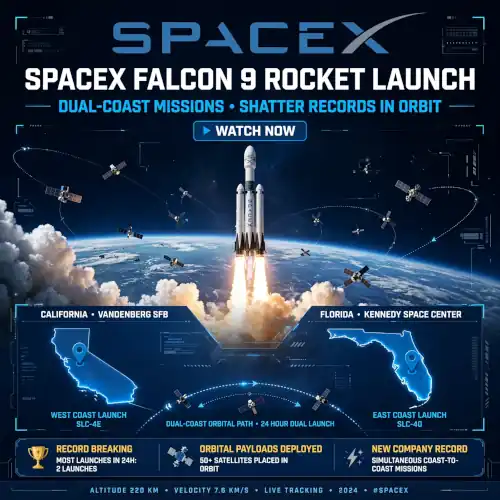

USA Space Science News: The night skies above both American coasts lit up with roaring brilliance as SpaceX executed back-to-back Falcon 9 orbital missions just minutes apart. In a breathtaking demonstration of launch cadence and engineering precision, two separate orbital-class rockets roared to life from opposite sides of the country, delivering critical national security and commercial telecommunications payloads into low Earth orbit.
From the subtropical launchpads of Cape Canaveral Space Force Station in Florida to the rugged coastal bluffs of Vandenberg Space Force Base in California, the twin operations underscored why the Falcon 9 remains the undisputed workhorse of modern spaceflight. Spectators across both states witnessed the golden pillars of rocket exhaust climbing into the stratosphere, followed minutes later by the signature descent burns and pinpoint autonomous landings that have redefined global aerospace logistics.
Coast-to-Coast Thunder: The Doubleheader Sequence
The rapid-fire launch sequence began on the West Coast, where a two-stage Falcon 9 rocket stood poised atop Space Launch Complex 4 East (SLC-4E) at Vandenberg Space Force Base. Under crisp Pacific coastal skies, the countdown proceeded without a single technical hiccup. As the automated launch sequencer took control in the final sixty seconds, high-pressure propellant tanks pressurised to flight levels, the nine Merlin 1D engines ignited in precise sequence, and the 230-foot rocket lifted free of its launch mount in a surge of 1.7 million pounds of thrust.
The vehicle carried the classified USSF-366 mission for the United States Space Force, carving a southbound polar trajectory out over the open waters of the Pacific Ocean.
Before the sonic rumbles had even faded from the California coastline, launch control teams in Hawthorne, California, and at the Florida Space Coast shifted immediate focus across the continent. At Space Launch Complex 40 (SLC-40) at Cape Canaveral Space Force Station, a second Falcon 9 stood fully fueled with superchilled liquid oxygen (LOX) and rocket-grade kerosene (RP-1).
Just 38 minutes after the California liftoff, the Florida vehicle ignited its engines and surged into the twilight sky over the Atlantic Ocean, carrying the Globalstar 2-R constellation replenishment satellites. The twin launches set a new benchmark for the shortest interval between two orbital missions launched by a single commercial entity.
Payloads Driving Global Connectivity and Defence
Each mission carried high-stakes orbital hardware designed to support advanced communications, direct-to-device connectivity, and national security infrastructure.
- USSF-366 (National Security Space Launch): Flown for the U.S. Space Force from Vandenberg, this mission deployed specialised orbital technology aimed at enhancing space domain awareness, tactical communications, and satellite resilience. Due to the sensitive nature of the primary cargo, real-time coverage concluded shortly after the upper stage entered its initial parking orbit.
- Globalstar 2-R (Launch 1): The Florida launch deployed eight next-generation satellites into low Earth orbit for Globalstar. These satellites reinforce direct-to-cellular emergency messaging, satellite tracking, and IoT data services for millions of smartphone users worldwide.
- Starlink Constellation Cadence: These launches build on an intense operational tempo that includes regular launches of 24 to 29 next-generation broadband satellites every few days, expanding high-speed, low-latency internet access across underserved global regions.
Anatomy of a Launch: From Max Q to Precision Touchdown
While a rocket launch looks effortlessly majestic from the ground, the ascent is a violent exercise in physics and automation. Every Falcon 9 flight follows a tightly synchronised sequence of events:
[Liftoff (T-00:00)] ──► [Max Q (T+01:12)] ──► [MECO (T+02:26)] ──► [Stage Separation (T+02:30)]
                                                                               │
[Orbital Insertion (T+08:40)] ◄── [Landing (T+08:13)] ◄── [Entry Burn (T+05:59)] ◄┘
- Engine Chill & Final Checks (T-00:07 to T-00:01): The flight computer verifies cryo-cooling of the turbopumps and pressurises both fuel and oxidiser tanks to high operational levels.
- Liftoff & Max Q (T+00:00 to T+01:12): Clearing the tower, the rocket accelerates through the dense lower atmosphere, reaching the point of Maximum Aerodynamic Pressure (Max Q)—the moment the vehicle experiences its peak mechanical stress.
- Main Engine Cutoff (MECO) & Stage Separation (T+02:26 to T+02:30): The nine Merlin engines on the booster shut down simultaneously. Pneumatic pushers separate the booster from the second stage, which ignites its single vacuum-optimised Merlin Vacuum (MVac) engine to propel the payload into orbit.
- Boostback & Re-entry Burns (T+05:59): Using grid fins and cold-gas thrusters to orient itself against atmospheric friction, the first-stage booster relights three engines to brake safely through the searing heat of hypersonic re-entry.
- Autonomous Landing (T+08:13): As the second stage delivers its payload to target velocity, the booster executes a final landing burn, deploying four carbon-fibre landing legs to settle onto an autonomous droneship stationed hundreds of miles offshore in the open ocean.
Both first-stage boosters completed their descent burns during the dual-launch event, sticking their landings aboard the autonomous sea-going platforms Of Course I Still Love You and A Shortfall of Gravitas.
The Reusability Revolution: Turning Science Fiction into Routine
Not long ago, an orbital rocket was an expensive, single-use consumable—a colossal machine destined to drop into the ocean and sink to the seabed after a single five-minute flight. SpaceX’s relentless mastery of booster recovery and rapid refurbishment has permanently altered the economics of spaceflight.
Individual Falcon 9 first-stage boosters routinely log 15 to 20 or more flights apiece. Between missions, technicians inspect the thermal protection shields, refurbish engine seals, and re-certify the titanium grid fins before mounting the booster beneath a fresh second stage.
This fleet reusability has driven the marginal cost of access to low Earth orbit down by an order of magnitude, enabling private companies, universities, and sovereign research agencies to book rides to orbit that were once cost-prohibitive.
The Spectator Experience: Twilight “Space Jellyfish” and Sonic Booms
For skywatchers and coastal residents, Falcon 9 launches have evolved into must-see cultural spectacles. Because of the timing of evening and dawn liftoffs, high-altitude exhaust plumes often catch direct sunlight above the twilight horizon while the surface below sits in darkness.
The resulting atmospheric illumination—frequently referred to as the “space jellyfish” effect—creates glowing, multi-colored nebulae across hundreds of square miles. The expanding water vapour, carbon soot, and unburnt kerosene illuminate in iridescent blues, whites, and oranges against the night sky.
Along the Central Coast of California and Florida’s Space Coast, inland communities frequently experience sharp double sonic booms echoing across counties as returning rocket stages punch back through the sound barrier during descent.
Looking Ahead: The Highway to Low Earth Orbit
With over 90 to 100 orbital launches conducted annually, the relentless cadence of the Falcon 9 program shows no signs of slowing. SpaceX continues to utilise the operational stability and steady revenue of its Falcon fleet to fund development of its next-generation, fully reusable heavy-lift Starship architecture.
Whether delivering government defence assets, expanding broadband constellations, or carrying astronauts to the International Space Station, today’s record-breaking dual launches demonstrate that routine, rapid access to orbit is no longer a future ambition—it is an everyday reality. As both rockets settled safely into their orbits and recovery cradles, humanity’s highway to space grew just a little bit busier.
Check out also what’s trending now in the USA below
Editor’s Pick
-
Read more: 1950 Rock star Freddy Cannon passed away at 89, but how? Read More
1950 Rock star Freddy Cannon passed away at 89, but how? Read More
on
-
Read more: A Seattle Shooting today killed 3 and injured 11 more | 2 suspects were caught.
A Seattle Shooting today killed 3 and injured 11 more | 2 suspects were caught.
on
-
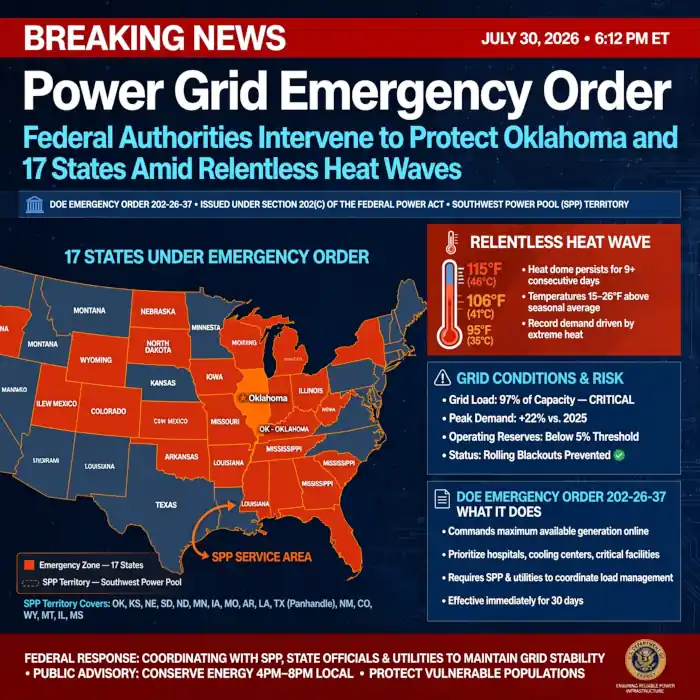 Read more: Power Grid Emergency Order: Federal Authorities Intervene to Protect Oklahoma and 17 States Amid Relentless Heat Waves
Power Grid Emergency Order: Federal Authorities Intervene to Protect Oklahoma and 17 States Amid Relentless Heat Waves
on
-
 Read more: Situational Awareness: Inside the Trillion-Dollar AI Mobilization Reshaping Global Security and Tech Markets
Situational Awareness: Inside the Trillion-Dollar AI Mobilization Reshaping Global Security and Tech Markets
on